
When choosing an LCD display module for bright environments, engineers often look first at the brightness rating in nits. That is an important starting specification, but it is also one of the most misunderstood. A higher nit value means the module can emit more light, but that alone does not mean the screen will remain readable under sunlight.
Brightness, measured in nits, describes how much light an LCD display module emits from its surface. Sunlight readability is different. It depends on whether the display can maintain usable contrast under strong ambient light, which requires not only sufficient brightness but also effective reflection control across the full optical stack.
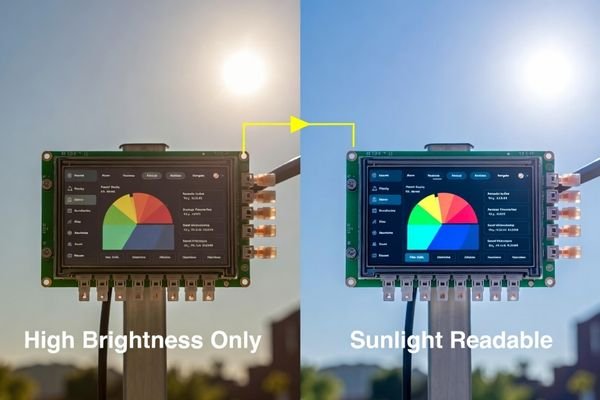
Based on my LCD display module integration work at LCD Module Pro, I often see teams select a high-brightness module—sometimes 1000 nits or more—only to discover that it still performs poorly once installed in the final product. The screen may look impressive on a specification sheet and even appear bright in a lab, yet still become washed out in outdoor or window-facing use. In most of these cases, the problem is not that the backlight is too weak. The real issue is that uncontrolled reflections are overpowering the visible image.
A high-brightness LCD module can still fail in sunlight if the front surface reflections are not controlled. That is why sunlight readability1 should be treated as a system-level optical goal rather than as a backlight number. Engineers need to evaluate brightness together with surface reflection, optical bonding, cover lens design, and contrast retention. This article explains what brightness in nits really means, why it does not equal sunlight readability, and how to evaluate display visibility correctly in real applications.
What Does Brightness (Nits) Mean in an LCD Display Module?
Before discussing sunlight readability, it is essential to define brightness from an engineering perspective.
Brightness, also called luminance, measures how much light an LCD screen emits from its surface. It is typically specified in nits, where 1 nit equals 1 candela per square meter (cd/m²).
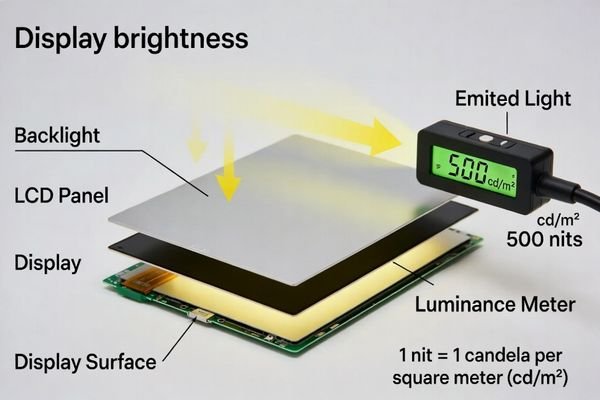
In practical terms, the nit rating provides a standard way to compare how much visible light different LCD display modules can produce. Brightness measures emitted light, not reflected ambient light.
The Measurement of Luminance
If a specification sheet states that a display has a brightness of 500 nits, it means that a white area on the screen emits 500 candelas of light per square meter. A higher nit value generally indicates a stronger backlight system and greater light output through the LCD stack.
This specification is useful because it gives engineers a common baseline. A typical indoor display may operate around 250 to 300 nits, while an industrial LCD display module designed for bright environments may reach 1000 nits or more. In that sense, nits are a straightforward measurement of screen luminance2.
Brightness as a Baseline Spec
Brightness is an important baseline parameter because it helps determine whether a display is even suitable for further evaluation in a bright environment. A very low-brightness module is unlikely to perform well in outdoor or high-ambient-light conditions, regardless of what optical enhancements are added later.
However, brightness is still only a starting point. It tells you how much light the display can emit, but it does not tell you how much ambient light the display will reflect, how much contrast it can preserve in real use, or whether the final installed system will remain readable. That is why brightness should be treated as one important parameter within a larger visibility strategy rather than as a standalone answer.
Why Is Brightness Only One Part of Display Visibility?
Real display visibility depends on a balance between emitted light and reflected light. That balance determines whether the screen image remains distinguishable under ambient illumination.
Display visibility is determined by the relationship between the light emitted by the display and the light reflected from its surface. Even a bright screen can become difficult to read if strong ambient reflections reduce effective contrast and wash out the image.
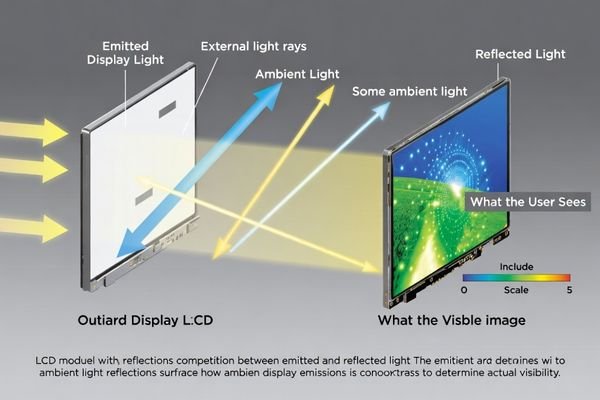
When engineers evaluate a display in the field, the key question is not simply how bright the backlight is. The more important question is whether the displayed image still stands out once sunlight or strong ambient light reaches the front surface.
A high nit value improves light output, but it does not guarantee sunlight readability. If a glossy or untreated front surface reflects too much ambient light, the visible image can lose contrast and appear faded even though the backlight is strong. In that case, the display may be bright in isolation but still perform poorly in actual use.
This is why a display that looks bright in a dark lab may still fail outdoors. Reflected ambient light can overpower the displayed image if the optical structure is not designed to control it. Air gaps, untreated cover glass, poor reflection management, and weak contrast retention can all reduce practical visibility. In real projects, engineers should evaluate brightness together with reflection control3 rather than assuming that backlight power alone will solve the problem.
What Is the Difference Between High Brightness and Sunlight Readability?
High brightness and sunlight readability are closely related, but they are not the same thing. Confusing them often leads to incorrect module selection.
High brightness is a luminance specification that describes display light output in nits. Sunlight readability is a system-level performance result that describes whether the display remains usable under strong ambient light by combining brightness, reflection control, and effective contrast retention.
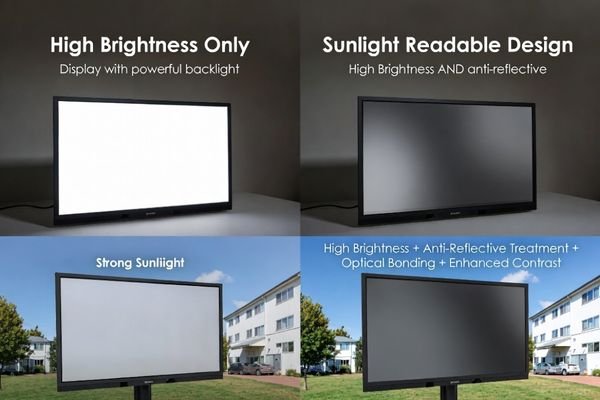
Brightness is a measurable output value. Sunlight readability is an application outcome.
| Feature | High Brightness4 | Sunlight Readability |
|---|---|---|
| Definition | Measures the light emitted from the display surface. | Measures whether the display remains usable in bright ambient light. |
| Primary Metric | Nits (cd/m²) | Effective contrast and readability under real lighting conditions |
| Main Focus | Backlight output | Balance between emitted light and reflected light |
| Key Influences | Backlight design, LED efficiency, power | Brightness, optical bonding, surface reflection control, contrast retention, cover lens design |
| Engineering Goal | Increase luminance | Preserve readable image quality in sunlight or strong ambient light |
A high-brightness LCD module can still fail in sunlight if the front optical design is poor. Conversely, a well-engineered display with a properly designed optical stack may achieve strong outdoor readability without simply pushing the highest possible backlight output. Sunlight readability should therefore be treated as a full-system optical outcome, not as a direct synonym for nits. For specific guidance on designing the right visibility strategy for your application, my team at info@lcdmodulepro.com can provide engineering support.
Which Optical Factors Determine Whether a Display Is Truly Sunlight Readable?
Sunlight readability depends on the full optical stack rather than on brightness alone. Reflection control is often where real-world performance is won or lost.
A display becomes truly sunlight readable only when high brightness is combined with effective control of surface and internal reflections. Key factors include AG or AR treatment, optical bonding, cover lens design, contrast retention, and the overall optical structure of the LCD display module.
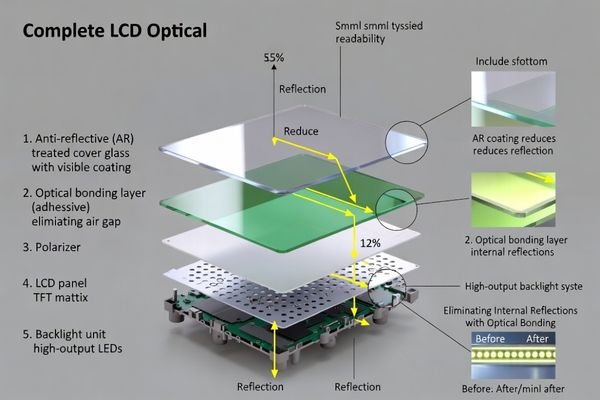
When reviewing outdoor-facing designs, I do not treat brightness as the only checkbox. In most outdoor-facing projects, brightness must be evaluated together with reflection control.
The Role of Reflection Control
The first major factor is front-surface reflection. If too much ambient light is reflected back at the user, the image loses effective contrast and readability declines.
- Anti-Glare (AG): AG treatment diffuses reflections and reduces sharp mirror-like glare. This can improve practical readability in bright environments, though the exact visual result depends on the haze level and the viewing conditions.
- Anti-Reflective (AR): AR coatings reduce reflected light through optical interference. A well-designed AR surface can significantly lower reflectance and help preserve visible contrast outdoors.
Brightness measures emitted light, not reflected ambient light. That is why reflection control is essential to sunlight readability.
The Impact of Optical Bonding
Optical bonding5 is often one of the most effective ways to improve sunlight readability. In a standard display structure, an air gap between the cover lens and the LCD can create internal reflections that reduce contrast and make the screen look washed out in bright conditions.
By filling that gap with a clear optical adhesive, optical bonding reduces internal reflection and improves the perceived contrast of the display. Optical bonding can improve sunlight readability by reducing internal reflections. In many real applications, this optical improvement is more meaningful than simply increasing the backlight power alone.
Because sunlight readability depends on the full optical stack, brightness requirements should always be defined from the real application environment rather than from a standalone nit target.
How Should Engineers Evaluate Brightness Requirements in Real Applications?
The correct way to define brightness is not to start with a generic number from a datasheet. The better approach is to work backward from the actual use environment and readability requirement.
Engineers should specify brightness by evaluating the real ambient-light environment, the planned optical stack, the viewing conditions, and the target readability level. Brightness should be selected as part of a complete visibility strategy rather than as an isolated number.

Based on the projects I support, a practical evaluation process usually includes three questions: how much ambient light the product will face, how the optical stack will influence reflections and contrast, and what level of readability the application actually requires.
Start with the environment. A display inside a shaded industrial cabinet, behind a windshield, or under a canopy has different needs from a kiosk installed in direct sunlight. Engineers should determine whether the product is used indoors, near windows, in bright commercial lighting, or fully outdoors. The operating angle, enclosure shading, and viewing distance all matter.
Next, evaluate the complete optical stack6. If the design includes untreated cover glass and an air gap, reflections may be severe, and simply increasing brightness may lead to higher power consumption without solving the actual readability problem. If the design includes optical bonding and AR or AG treatment, the system may achieve better visible performance with a lower nit value than expected. In many projects, optical engineering is a more efficient path to sunlight readability than backlight escalation alone.
Finally, define the real readability target. Some products only need to look bright during a demonstration. Others must remain readable for continuous daily use in uncontrolled light. Those are not the same design goals. Engineers should therefore specify brightness together with reflection control, optical bonding, thermal constraints, and power budget. This system-level approach leads to more reliable field performance, better energy efficiency, and more realistic design decisions.
FAQ
What does nits mean on an LCD display module?
Nits measure the luminance of the display, showing how much light the LCD module emits from its surface.
Does a higher nit value always mean better outdoor readability?
No. Higher brightness helps, but outdoor readability also depends on reflection control, optical bonding, contrast retention, and the full optical structure.
Why can a bright screen still be hard to read in sunlight?
Because strong ambient reflections can wash out the image and reduce effective contrast, even when the backlight output is high.
Is sunlight readability only about backlight power?
No. It is the combined result of brightness, reflection control, optical bonding, surface treatment, and contrast performance.
Can optical bonding improve sunlight readability?
Yes. Optical bonding can significantly reduce internal reflections and improve perceived contrast, which often makes the display more readable in bright conditions.
How should brightness be specified for an industrial LCD module?
Brightness should be defined together with the real application environment, optical stack, viewing conditions, and readability target rather than as a standalone value.
Conclusion
Brightness in nits tells you how much light an LCD display module can emit, but it does not by itself define whether the display will remain readable under sunlight. Brightness is a luminance value, while sunlight readability is a full-system optical outcome.
At LCD Module Pro, we recommend evaluating brightness together with the entire optical stack, including reflection control, optical bonding, cover lens design, contrast retention, power limits, and thermal constraints. The right engineering decision is not simply to choose the highest nit number, but to build a display system that maintains usable contrast in the real environment where it will operate. That is how a module becomes not just bright on paper, but genuinely readable and reliable in the field.
✉️ info@lcdmodulepro.com
🌐 https://lcdmodulepro.com/
-
Understanding sunlight readability is crucial for optimizing display performance in outdoor settings. ↩
-
Exploring screen luminance will enhance your knowledge of display performance and suitability. ↩
-
Exploring reflection control techniques can help enhance display performance in various lighting environments. ↩
-
Understanding High Brightness is crucial for optimizing display performance in various lighting conditions. ↩
-
Learn about the advantages of optical bonding in reducing reflections and enhancing display clarity. ↩
-
Understanding the optical stack is crucial for optimizing display performance and achieving desired readability in various environments. ↩