In equipment and device development, choosing between a standard LCD module and a custom LCD module is rarely just a purchasing decision. It affects enclosure design, electrical integration, optical performance, validation workload, and long-term supply planning. An off-the-shelf display may look like the faster option at first, but in real projects, that convenience often comes with hidden compromises.
A custom LCD module becomes worth evaluating when a standard LCD module can no longer meet the product’s mechanical, interface, environmental, optical, or lifecycle requirements without creating additional project risk. In that situation, the decision is no longer about convenience alone. It becomes a decision about product fit, development efficiency, and long-term stability.
This question matters most to product managers, hardware engineers1, and sourcing teams working on real equipment programs. In practice, the issue is often not whether a standard display can light up on the bench. The real issue is whether a standard LCD module can fit the product, integrate cleanly, perform reliably in the target environment, and remain supportable over the intended lifecycle.
Decision Summary
- Choose a standard LCD module when the product can adapt to the display.
- Choose a custom LCD module when the display must adapt to the product.
- If more than one critical area is being compromised, a custom LCD module usually becomes the safer path.
From an engineering perspective, I often see teams try to force a standard LCD module into a design where it only partially fits. That usually creates a chain reaction: a larger enclosure than planned, extra adapter boards, more cable complexity, unstable connectors, weak sunlight readability, or repeated design revisions. The initial savings from the standard part can quickly be consumed by rework, validation effort, and a less refined final product.
A custom LCD module is not about overengineering. It is about defining the display around the product’s actual needs. That may include module size, active area position, interface, brightness, touch structure, temperature performance, or lifecycle planning. The key is identifying the point at which a standard LCD module2 stops being a shortcut and starts becoming a constraint.
When Standard LCD Modules Still Make Sense
A standard LCD module is still a practical choice when the product can be designed around the display’s existing specifications. Standard LCD modules are often the right option for projects with flexible enclosure space, common interfaces, moderate indoor brightness requirements, limited environmental stress, and shorter product lifecycles.
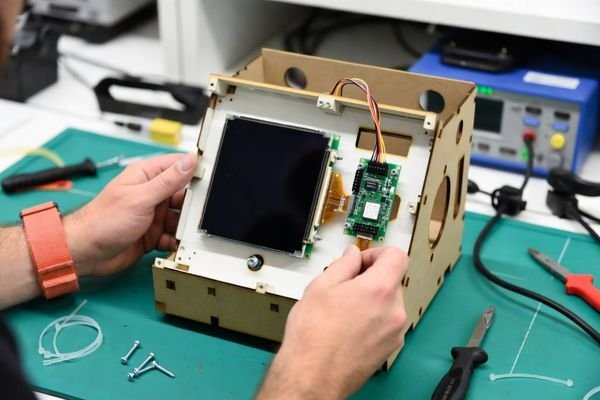
In many projects, a standard LCD module is the right starting point. If the enclosure has enough space, the mainboard already supports a common interface such as LVDS or MIPI, and the application is primarily indoors, using an off-the-shelf display can reduce upfront engineering work and accelerate early validation.
The Flexibility Trade-off
The core advantage of a standard LCD module is speed. There is no need to redefine the basic display architecture, and there is often no additional non-recurring engineering effort at the beginning. That makes standard LCD modules useful when the display is not the main design constraint.
The trade-off is that the product must accept the display’s limitations. The bezel size, active area placement, connector position, thickness, and optical performance become fixed design boundaries. If those boundaries still work for the product, a standard LCD module remains a sensible option.
Ideal Scenarios for Standard LCD Modules
Standard LCD modules are particularly suitable for:
- Early-stage prototyping and proof-of-concept work, where the goal is to validate software or core functionality quickly.
- Internal equipment or limited-run systems, where long-term supply and industrial design are not the main concerns.
- Products with flexible mechanical design, where enclosure dimensions and mounting can be adjusted around a standard LCD module.
- Applications with moderate indoor operating conditions, where high brightness, wide temperature, or ruggedization are not required.
Mechanical Constraints That Require a Custom LCD Module
A custom LCD module becomes necessary when a standard panel no longer matches the product’s mechanical design. The issue may be the outline size, active area location, bezel width, mounting points, thickness, or overall integration into the enclosure.
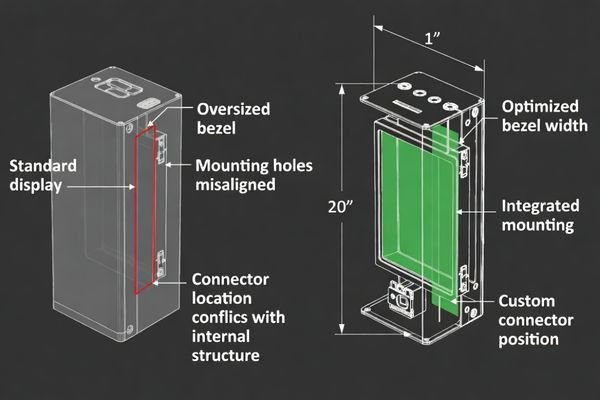
Mechanical mismatch is one of the most common triggers for a custom LCD module. A standard 10.1-inch display may offer the right resolution, but if the bezel is too wide, the product may end up looking outdated or bulkier than intended. In another case, the display may fit the front opening visually, but its mounting holes do not align with the chassis, forcing the team to design additional brackets or adapters.
Thickness can create the same problem. In handheld devices, wall-mounted control panels, or compact embedded equipment, a few millimeters can determine whether the product meets its form factor target3. A standard LCD module with a thicker backlight stack, separate touch layer, or poorly placed connector can push the design beyond its physical limits.
At that point, the question is no longer whether a standard module can function. The question is whether it can fit the product without degrading usability, assembly reliability, or industrial design quality. When the product is being reshaped just to accommodate the display, a custom LCD module usually deserves serious consideration.
Interface and Integration Limits in Standard LCD Modules
A display that looks acceptable on paper can still create major integration challenges once it is connected to the actual system. Interface compatibility is often where a standard LCD module begins to create hidden engineering cost.
A custom LCD module becomes the better option when a standard display’s interface, connector, pinout, timing, or power requirements create unnecessary integration risk.
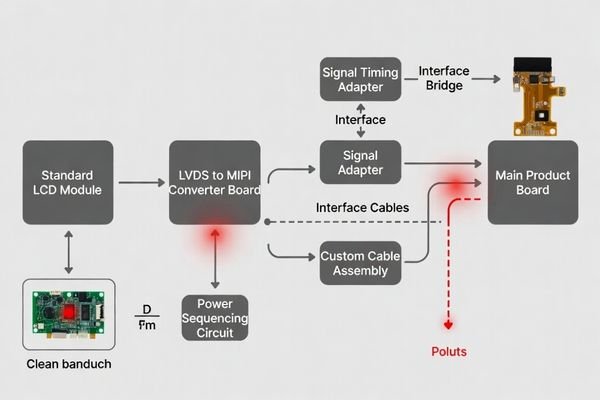
The interface is not just a connector choice. It affects timing compatibility, cable routing, signal integrity, EMI behavior, power sequencing, and validation complexity. A module may seem usable in isolation, but once it meets the mainboard, problems can emerge.
For example, a mainboard may be designed around eDP4 while the candidate display only exposes LVDS. Or the selected display may require an awkward connector orientation that forces a long adapter cable through a crowded enclosure. In many cases, the team ends up designing a “board to fix the board,” which adds cost and more failure points.
In our project reviews at LCD Module Pro, this is usually the point where we stop looking only at the display datasheet and start looking at the system around it. We typically check four things early: the host interface type, connector direction, allowable cable path, and power-sequencing assumptions. If two or more of those already require workarounds, the project often moves from simple adaptation into custom LCD module evaluation.
| Integration Area | Standard LCD Module Risk | Custom LCD Module Advantage |
|---|---|---|
| Connector / Pinout | Extra adapter cables or converter boards | Connector and pinout can be aligned with the host system |
| Timing Compatibility | Firmware or hardware workarounds | Timing can be defined around the target platform |
| Power Design | Additional regulators or sequence logic | Power rails can be matched to the product architecture |
| Cable Routing | Crowded routing and fragile interconnects | FPC design can support cleaner integration |
| EMI / EMC | Longer or improvised interconnects increase compliance risk | Layout can be optimized earlier in development |
When interface adaptation becomes a repeated workaround rather than a clean design choice, it is usually a sign that the display should be defined around the system rather than forced into it. In that situation, a custom LCD module often reduces total engineering friction.
Environmental and Optical Demands Beyond Standard Designs
A standard LCD module is usually designed for general indoor use. Once the product must perform in sunlight, wide temperature ranges, vibration, or continuous-duty environments, the display often becomes a major engineering variable rather than a simple catalog component.
A custom LCD module often becomes the safer choice when brightness, optical performance, touch behavior, thermal design, or durability must be matched to the real operating environment.
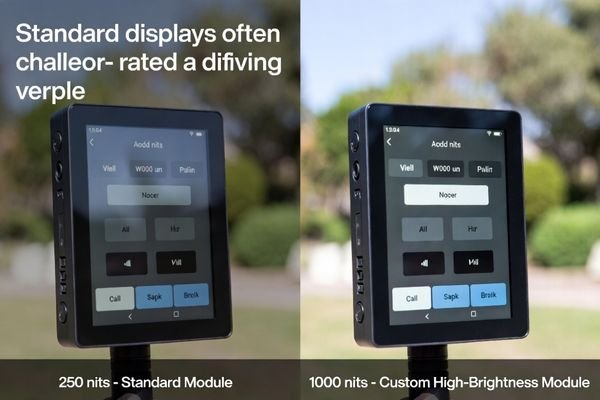
Standard brightness levels around 250 to 300 nits may be acceptable indoors, but they are often not enough for kiosks, transportation systems, outdoor equipment, or semi-outdoor terminals. Likewise, a standard air-gap stack may appear acceptable in the lab, yet become unreadable in bright ambient light because of reflection and contrast loss.
Optical Performance for Real-World Use
When the application environment is demanding, optical design becomes project-specific.
- High brightness requirements: Outdoor and high-ambient-light equipment often needs 800 nits, 1000 nits, or more.
- Optical bonding5: Eliminating the air gap between display and cover lens can improve readability and perceived contrast.
- Surface treatment: Anti-glare or anti-reflective treatments may be required depending on the viewing environment.
- Touch structure: Touch performance may need to support gloves, moisture, thicker cover lenses, or a specific user interface behavior.
A display that looks fine on a bench indoors may fail visually in the actual field environment. That is why brightness and optics should be treated as system requirements, not only product specifications.
In our engineering reviews, brightness is rarely treated as a standalone number. We usually look at viewing distance, ambient light exposure, cover lens structure, and the thermal limits of the enclosure before deciding whether a catalog display is still realistic or whether a custom optical stack is more appropriate. That prevents teams from choosing a nominal nit value that sounds strong on paper but does not hold up in actual use.
Durability and Thermal Design
Environmental adaptation is not only about visibility. It also affects reliability.
A standard LCD module may only be rated for limited operating temperature ranges, while the actual product may need to work in cold outdoor conditions, hot enclosures, or systems with heavy daily duty cycles. In high-brightness designs, backlight heat must also be managed correctly. Without enough thermal planning, LED aging accelerates, image uniformity can degrade, and long-term reliability becomes harder to control.
👉 Solutions:
For applications such as transportation systems, marine environments, industrial controls, and smart terminals → Explore our Solutions
👉 Modules:
For display types such as high brightness, bar-type, and custom display formats → Explore our Modules
👉 Engineering:
To evaluate the right path for your specific project constraints → Discuss your custom display project
Lifecycle and Supply Risks in Long-Term Equipment Programs
For long-lifecycle equipment, the display decision is not only technical. It is also a supply and change-management decision. A standard LCD module may be easy to source at the beginning, but that does not automatically make it the lowest-risk choice over the life of the product.
In long-term equipment programs, a custom LCD module can provide better control over change management, version consistency, and supply planning when compared with relying on a standard display designed for broader market turnover.
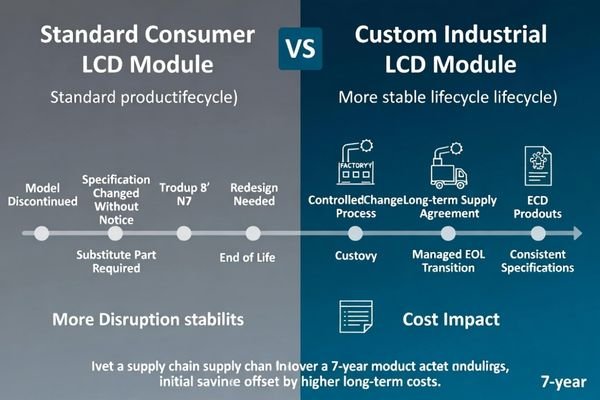
This issue becomes more important in medical, industrial, transportation, and professional systems where the product lifecycle can extend for many years. If a standard LCD module is changed or discontinued midway through the program, the resulting redesign can affect mechanics, optics, firmware, regulatory validation, and field service planning.
Supply Continuity Matters More Than Unit Price
A lower initial unit price can be misleading if the display creates later redesign risk. The real cost is not only what is paid per module today. It is also the cost of qualification, documentation updates, tooling changes, firmware revisions, and replacement management if the display changes later.
Change Management Is Part of the Engineering Decision
A custom LCD module does not eliminate all supply risk6, but it can make change control more structured and transparent when managed properly. For equipment programs with long service expectations, that predictability can be more valuable than the convenience of choosing a readily available off-the-shelf display.
In long-lifecycle projects, we usually confirm four planning inputs early: expected service life, acceptable change-notice window, replacement strategy, and annual volume range. Those factors often affect the display decision more than a small difference in initial unit price, because they determine how expensive a future display change would actually be.
The Real Choice Is About Project Risk and Product Fit
The decision between a standard LCD module and a custom LCD module should not be reduced to a simple comparison of upfront price. In real projects, the more important question is whether a standard display introduces compromises that create downstream risk.
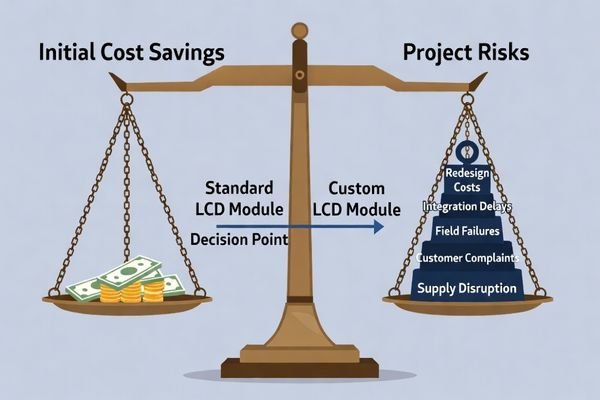
A standard LCD module may appear to save money at the start. But that advantage weakens quickly if it leads to:
- repeated mechanical redesign,
- unstable electrical integration,
- poor readability in the target environment,
- extended validation effort,
- or uncontrolled supply changes later in the program.
To make the decision easier, it helps to compare the two paths directly:
| Decision Factor | Standard LCD Module | Custom LCD Module |
|---|---|---|
| Initial Speed | Faster for early validation | Slower at the start due to definition and development |
| Mechanical Fit | Limited to existing form factors | Can be defined around the product |
| Interface Fit | May require workarounds | Can align more closely with host architecture |
| Optical / Environmental Fit | Limited by catalog design assumptions | Can be tuned to the application |
| NRE Requirement | Usually lower initially | Usually higher initially |
| Long-Term Change Control | Less predictable | Often more manageable in structured programs |
| Project Risk | Lower only when constraints are minimal | Lower when multiple constraints already exist |
The real comparison is not simply standard cost versus custom cost. It is short-term savings versus total project risk. A custom LCD module usually becomes worth evaluating when it reduces rework, schedule pressure, integration problems, and long-term uncertainty.
What to Prepare Before Starting a Custom LCD Project
Once it becomes clear that a standard LCD module may not be enough, the next step is not blind product comparison. It is requirement definition.
A custom LCD project moves more efficiently when the display requirements are defined clearly at the beginning, including mechanical, electrical, optical, environmental, and lifecycle expectations.
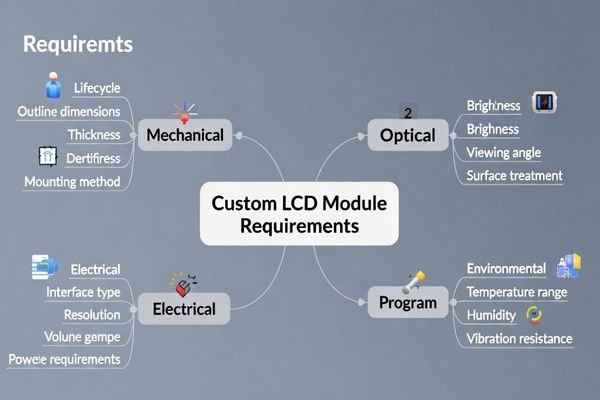
The more precisely the conditions are defined, the easier it becomes to assess feasibility and reduce unnecessary iteration. The most useful inputs usually include:
- Mechanical requirements
- Outline dimensions
- Thickness target
- Active area size and position
- Mounting method
- Electrical and interface requirements
- Resolution
- Interface type
- Connector preference
- Power conditions
- Optical and environmental requirements
- Brightness target
- Viewing angle expectations
- Operating temperature range
- Need for optical bonding, anti-glare, or anti-reflective treatment
- Touch requirements
- PCAP or resistive
- Cover lens design
- Glove touch, water touch, or special usage conditions
- Program requirements
- Product application
- Annual volume
- Expected lifecycle
- Reliability expectations
In our first-round feasibility reviews, we usually prioritize five inputs first: mechanical envelope, interface, brightness target, operating conditions, and lifecycle expectation. When those five are clear, it becomes much easier to judge whether a project can stay with a standard LCD module or whether it should move into custom LCD module development early.
When these conditions are available early, engineering discussions become much more productive because they focus on solution definition instead of guesswork.
👉 Engineering:
When your project already has clear constraints in mechanics, interface, optics, or lifecycle → Discuss your custom display project
A Practical Rule for Choosing Standard or Custom LCD Modules
A useful way to evaluate the decision is to count how many critical areas are already being compromised by the standard LCD module.
If the project is already facing meaningful compromise in more than one area—such as mechanics, interface, brightness, temperature, touch, or lifecycle—the display is no longer just a purchased component. It becomes a system-level design variable.
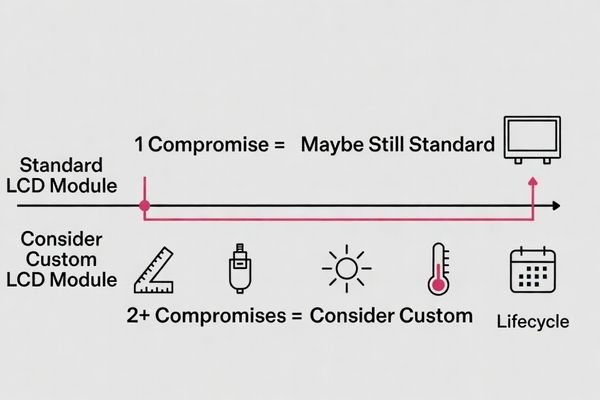
A single compromise may still be manageable. A bezel that is slightly wider than ideal, for example, may not justify custom development on its own. But once compromises start to accumulate, the risk picture changes.
If the standard LCD module has the wrong mounting geometry, the wrong interface, and insufficient brightness, the team is no longer making a simple trade-off. It is forcing a general-purpose component into a role it was not designed to fill. At that point, a custom LCD module often becomes the more stable and more sustainable path.
Not Sure If Your Project Requires a Custom LCD Module?
If your project already involves one or more of the following, it is usually worth evaluating a custom LCD module early:
- non-standard size or structure,
- interface compatibility issues,
- high brightness or outdoor use,
- demanding temperature or environmental conditions,
- long lifecycle or controlled supply requirements.
In these cases, the question is usually not whether a standard LCD module can be made to work somehow. The better question is whether forcing that standard LCD module into the product will add avoidable project risk.
If you can share your application, size target, brightness goal, interface, and project stage, our engineering team can help assess whether a standard LCD module is still realistic or whether a custom LCD module is the safer path.
👉 Get a project-specific evaluation:
Tell us your application, size, brightness, interface, and project stage → Discuss your custom display project
FAQ About Custom LCD Modules and Standard Displays
Is a custom LCD module always better than a standard display?
No. A custom LCD module is not automatically better in every case. A standard LCD module remains a strong option when the product can accept common sizes, standard interfaces, moderate operating conditions, and shorter lifecycle expectations. Customization becomes more valuable when the display must match the product more precisely in structure, integration, environment, or supply planning.
When does NRE for a custom LCD module become worthwhile?
NRE becomes worthwhile when it helps prevent larger downstream costs such as repeated mechanical changes, integration delays, redesigns, unstable supply, or long-term field issues. In many equipment projects, the real comparison is controlled upfront engineering cost versus larger downstream project risk.
Can a project start with a standard display and move to a custom module later?
Yes. That is a practical path for early proof-of-concept work. A standard LCD module can help validate software and core functions quickly. However, if the project already has clear constraints in structure, interface, brightness, temperature, or lifecycle, delaying customization may simply move the engineering burden to a later and more expensive stage.
What information is needed before discussing a custom LCD project?
The most useful information includes target dimensions, active area, resolution, interface, brightness goal, touch requirements, operating temperature, mounting constraints, application environment, lifecycle expectation, and estimated demand. These inputs make feasibility evaluation faster and more accurate.
Does customization always mean longer lead time?
Not always. Customization usually adds engineering and validation steps at the beginning, but it can also reduce hidden delays caused by workaround boards, repeated mechanical changes, unstable compatibility, or later redesign. In more complex products, a well-defined custom path may be more time-efficient overall.
Conclusion: Choose Standard When the Product Can Adapt — Choose Custom When the Display Must Adapt
The decision between a standard LCD module and a custom LCD module ultimately comes down to product fit and project risk. If the product can comfortably adapt to an off-the-shelf display, a standard solution is often the right choice. It can reduce early complexity and support faster development.
But when the display must fit a specific form factor, integrate with a specific system architecture, perform in a demanding environment, or remain manageable over a long lifecycle, the display needs to adapt to the product. That is the point where a custom LCD module usually becomes the more appropriate engineering decision.
If your project is already facing compromises in mechanics, interface, brightness, environment, or lifecycle planning, it is usually worth evaluating the custom path earlier rather than later.
To make that evaluation easier, it helps to start with a few concrete project inputs rather than a general inquiry. If you can share your application, target size, brightness goal, interface, and project stage, the discussion becomes far more practical from the beginning.
👉 Engineering:
For a project-specific evaluation of your display requirements → Discuss your custom display project
👉 Modules:
To review common display directions before starting development → Explore our Modules
👉 Solutions:
To see how different application types shape display requirements → Explore our Solutions
-
This resource provides valuable information on the key skills and knowledge areas that hardware engineers need to succeed in their roles. ↩
-
Learn about the potential pitfalls of standard LCD modules and how they can impact your project. ↩
-
Exploring form factor targets helps in creating products that meet design specifications and user needs, enhancing overall product success. ↩
-
Exploring eDP’s benefits can enhance your knowledge of display interfaces and improve your design choices. ↩
-
Explore how optical bonding enhances display performance, especially in challenging lighting conditions. ↩
-
Exploring supply risk management strategies can help ensure project stability and reduce unexpected costs in the future. ↩