
In LCD display module procurement and quality assurance, few issues create more disagreement than mura. This subtle non-uniformity may appear acceptable under one inspection condition and unacceptable under another. In many projects, the real problem is not only the mura itself, but the fact that the acceptance clause is too vague to be enforced consistently.
An executable mura clause must replace subjective language with defined inspection conditions and repeatable acceptance logic. That means specifying the exact test pattern, brightness setting, ambient light, viewing distance, warm-up time, zone definition, and rejection criteria for mura size, contrast, concentration, and location.
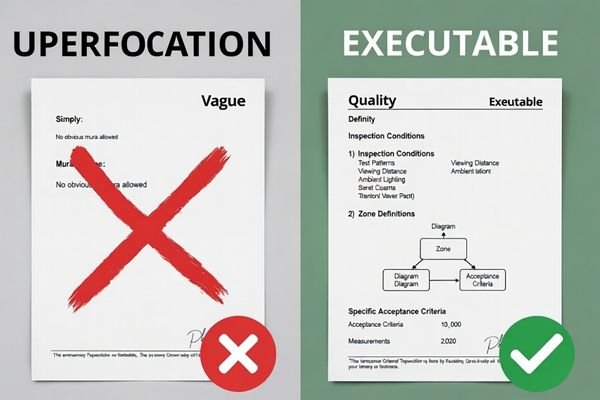
Based on my LCD display module integration work at LCD Module Pro, mura disputes usually do not begin with the panel alone. They begin when the buyer, supplier, and quality team are all looking at the same module under different assumptions. One team uses a bright office, another uses a dark inspection room, and neither side is working from the same acceptance method.
That is why a mura clause should be treated as a technical inspection procedure1, not as a loose appearance statement. A useful clause must define how inspection is performed, under what conditions the result is judged, and what specific findings are considered acceptable or rejectable. When written correctly, the clause becomes a shared quality tool rather than a trigger for negotiation.
Why Do Mura Clauses Often Fail in LCD Module Projects?
Mura clauses fail when they describe appearance expectations without defining inspection conditions.
Mura clauses often fail because they use vague wording such as “minor mura acceptable” or “no obvious mura” without defining the inspection method, viewing condition, or rejection boundary. As a result, different teams inspect the same LCD module and reach different pass/fail conclusions.
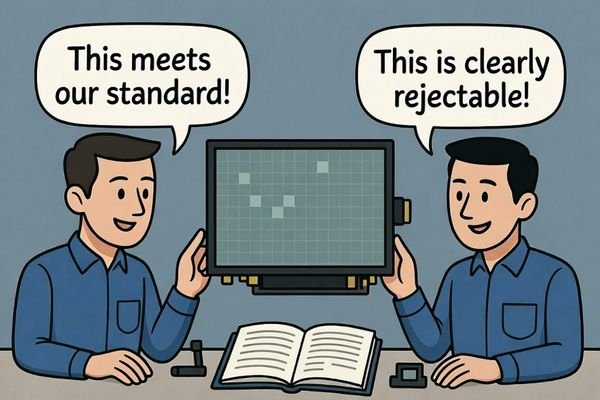
In real projects, this usually becomes visible during incoming inspection, pilot builds, or customer acceptance reviews. The supplier may argue that the panel meets its internal standard, while the customer or integrator rejects it because the mura is visible in the actual product environment. The disagreement happens because the clause does not control the test method tightly enough to make the judgment repeatable.
Mura visibility changes with grayscale pattern, display brightness, ambient lighting, viewing distance, thermal state, and even the product build condition. A mura that is nearly invisible on a white screen may become obvious on a mid-gray screen. A mura that seems acceptable in a bright office may become highly visible under darker evaluation conditions. If the clause does not define these variables, it does not define the inspection itself.
A clause that cannot be executed consistently is not a reliable quality standard2. It becomes a negotiation point, increases acceptance ambiguity, and makes corrective action much harder to enforce.
What Elements Make a Mura Clause Truly Executable?
An executable mura clause must define both the inspection method and the acceptance boundary.
A mura clause becomes executable only when another trained team can repeat the same inspection under the same conditions and reach the same conclusion. To achieve that, the clause must define inspection pattern, panel state, brightness, warm-up time, ambient light, viewing angle, viewing distance, and rejection criteria.
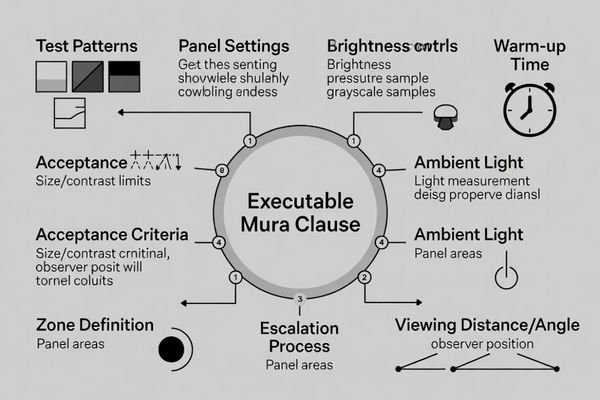
From a quality engineering standpoint, a strong mura clause3 should read like an operational inspection procedure rather than a general quality wish. The goal is repeatability. If the supplier, buyer, and auditor cannot reproduce the same process, the clause will not work in production.
A practical clause should usually define:
- Scope: Which product stage is covered, such as bare panel, bonded module, or finished device.
- Test pattern: Which grayscale images or uniform gray levels must be used.
- Panel operating state: Brightness setting, display mode, and warm-up time before inspection.
- Viewing condition: Ambient illumination, viewing angle, distance, and observation duration.
- Acceptance criteria: Mura size, contrast severity, density, clustering, and zone sensitivity.
- Dispute method: Joint review, reference sample comparison, or documented escalation process.
Another critical point is product form. A bare cell may show different mura characteristics from a bonded LCD module with a cover lens and enclosure. An executable clause must state clearly at which assembly stage inspection applies, otherwise the same display may appear to pass in one state and fail in another.
How Should You Define Inspection Conditions for Mura Evaluation?
Inspection conditions are essential because mura visibility changes with display state and viewing environment.
To define mura inspection conditions correctly, engineers should specify the display pattern, backlight level, warm-up duration, ambient light level, viewing angle, viewing distance, and whether evaluation is performed by naked eye or with supporting optical aids. These conditions should also reflect the real product application.
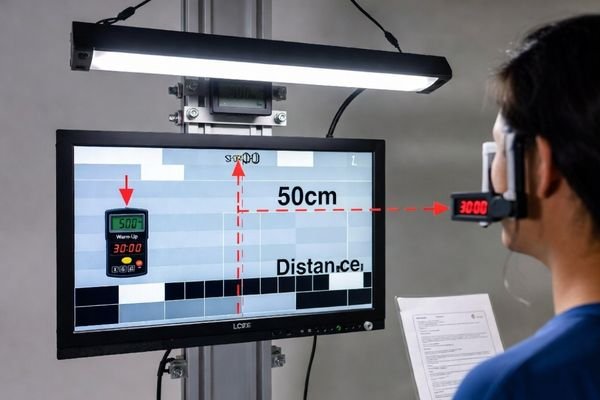
In practice, the inspection environment determines whether the clause measures real product risk or only a laboratory abstraction. A clause that is too strict for the actual use case may reject acceptable product unnecessarily. A clause that is too loose may allow visible mura to pass into the field.
The most useful approach is to define a stable baseline that reflects how the display will actually be used. If the LCD module is intended for an industrial HMI in a bright environment, a dark-room-only criterion may be too severe. If the product is used in a controlled low-light professional environment, the inspection condition should reflect that.
A structured mura inspection condition4 often includes the following:
| Parameter | Example Specification | Why It Matters |
|---|---|---|
| Test Pattern(s) | Full-screen uniform gray at 16, 32, 64, 128, and 192 gray levels (8-bit). | Mura visibility often changes strongly at specific grayscale levels. |
| Warm-up Time | Minimum 30 minutes of continuous operation before evaluation. | Thermal stabilization can affect mura visibility and backlight uniformity. |
| Brightness Setting | Backlight set to 100% of nominal inspection brightness. | Different luminance levels can change perceived mura severity. |
| Ambient Lighting | Inspection under controlled lighting, for example below 10 lux or defined office lighting. | External light can hide or exaggerate non-uniformity. |
| Viewing Distance / Angle | 50 cm ± 5 cm, perpendicular to display center, with a defined angular tolerance. | Mura visibility varies with observer position and distance. |
A mura clause becomes much stronger when these conditions are written as fixed inspection inputs rather than left to inspector preference.
How Do You Turn Subjective Appearance into a Defensible Acceptance Standard?
A defensible acceptance standard converts visual appearance into structured judgment logic.
To turn mura appearance into an enforceable standard, engineers should classify severity using defined rules for size, contrast, density, and location, then apply those rules under fixed inspection conditions. The decision should depend on agreed criteria, not on personal opinion.
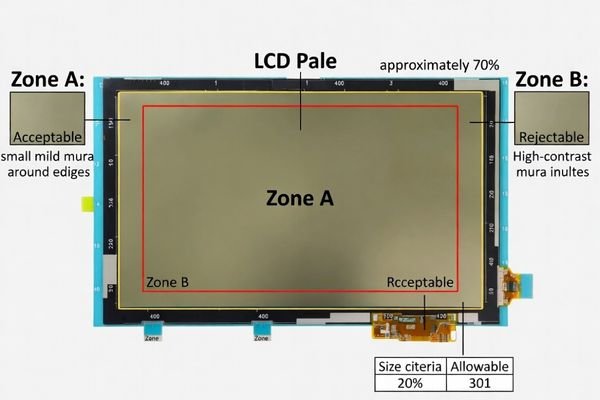
In practice, this means replacing loose wording with classification logic that can be repeated. A strong mura clause does not simply say that visible mura is unacceptable. It explains which kinds of mura are rejectable, in which zones, and under what conditions.
Define Severity and Location Rules
A practical first step is to divide the display into zones. A central viewing area is usually more critical than peripheral regions, especially for HMI, information display, and interface-driven products. A mura in the center often has higher visual and functional impact than a similar mura near the edge.
A clause may therefore define different limits by zone, for example:
- Central critical zone5: tighter size and quantity limits.
- Peripheral zone: slightly more relaxed limits.
- Cluster rule: grouped non-uniformity evaluated more strictly than isolated spots.
- Contrast rule: high-contrast mura treated more severely than soft or diffuse mura of the same size.
This kind of structure makes the acceptance logic more defensible because it reflects actual product risk rather than pretending every location has the same importance.
Establish an Escalation Process
Even a good mura clause will encounter borderline cases. That is why an executable clause should include a defined escalation path. Without it, the decision returns to opinion.
A practical escalation method may include:
- Joint inspection: buyer and supplier review the same unit under the same defined conditions.
- Reference sample comparison: comparison to approved golden samples or agreed limit samples.
- Captured image review: fixed-camera image comparison under controlled exposure and lighting.
- Documented engineering review: quality and engineering teams review borderline findings against the written clause.
This step is important because it turns difficult cases into a controlled decision process instead of a supplier argument.
How Do You Write Practical Mura Clauses That Suppliers and Buyers Can Actually Use?
A practical mura clause should be written as operational quality language that both supplier and buyer can execute consistently.
The most effective mura clauses define scope, inspection condition, viewing method, rejection criteria, zone rules, and escalation logic in a sequence that can be applied directly during IQC, production audit, or customer acceptance. A usable clause should reduce ambiguity, not just describe expectations.

Based on the projects I support, the most practical format is not a long narrative paragraph. It is a structured clause that reads almost like a working quality checklist. Each requirement should answer one of the core execution questions:
- What product state is being inspected?
- Under what display pattern and brightness?
- In what environment?
- From what viewing distance and angle?
- What constitutes rejectable mura?
- Which zones use stricter or looser criteria?
- What happens if the result is borderline?
A clause written this way becomes much easier to use across factories, audit teams, and incoming inspection points. It also makes supplier accountability6 stronger, because the requirement is no longer hidden behind vague language.
A good practical clause should also reflect the actual application. An LCD module used in a low-information background area may tolerate a different mura level than one used in a highly visible control interface. The best clauses are not generic. They are repeatable, application-relevant, and sustainable across production lots.
FAQ
What makes a mura clause non-executable?
A mura clause becomes non-executable when it relies on vague wording such as “slight” or “not obvious” without defining inspection pattern, brightness, viewing distance, ambient light, and rejection logic.
Why is viewing distance so important in mura inspection?
Because the same mura may be highly visible at a short distance and practically invisible at the actual use distance, so acceptance must be tied to a fixed and agreed observation condition.
Should a mura clause use only visual judgment?
Visual judgment is usually necessary, but it should be controlled by defined conditions and supported by structured criteria, reference samples, or escalation rules to reduce subjective disagreement.
Can one mura clause apply to every LCD module project?
Not always. Different module sizes, brightness levels, bonding structures, and end-use environments can change mura visibility, so the clause should reflect the real application.
Why should central and edge zones be treated differently?
Because non-uniformity in the central viewing area usually has a higher visual and functional impact than similar mura near peripheral regions, especially in interface-driven products.
How can suppliers and buyers reduce disputes over mura?
They can reduce disputes by agreeing in advance on test patterns, warm-up time, ambient light, viewing distance, acceptance zones, severity rules, and a documented review process for borderline cases.
Conclusion
Writing an executable mura clause for an LCD display module requires more than adding appearance language to a specification. A useful clause must convert subjective visual dissatisfaction into defined inspection conditions, repeatable judgment logic, and application-relevant acceptance boundaries. When the clause is written around real viewing conditions, product state, zone sensitivity, and escalation rules, it becomes easier for suppliers to follow and easier for buyers to enforce.
At LCD Module Pro, I recommend treating mura clause writing as a quality engineering task rather than a documentation formality. When teams define inspection inputs clearly and align the acceptance method before production, they reduce supplier disputes, improve incoming inspection consistency, and build a more reliable quality standard for long-term projects.
✉️ info@lcdmodulepro.com
🌐 https://lcdmodulepro.com/
-
Exploring technical inspection procedures can enhance your knowledge of quality assurance in manufacturing processes. ↩
-
Exploring reliable quality standards can enhance manufacturing processes and ensure consistent product quality. ↩
-
Understanding the mura clause is essential for ensuring consistent quality in production processes. ↩
-
Understanding best practices for mura inspection can enhance product quality and ensure compliance with industry standards. ↩
-
Understanding the Central critical zone is crucial for optimizing display quality and ensuring user satisfaction. ↩
-
Understanding supplier accountability can enhance your quality control processes and improve supplier relationships. ↩