
When selecting an LCD display module, engineers often need to choose between stronger anti-glare behavior and higher perceived image clarity. That decision should not be made from first impression alone. Haze validation is an application-specific optical verification step, and its real purpose is to determine which haze level delivers the best usability under the actual lighting and viewing conditions of the final product.
To validate haze trade-offs on an LCD display module, engineers should compare clarity and anti-glare performance under real application conditions. Haze validation should be based on usability under realistic lighting, viewing distance, and final optical stack configuration, not on appearance in controlled viewing alone.
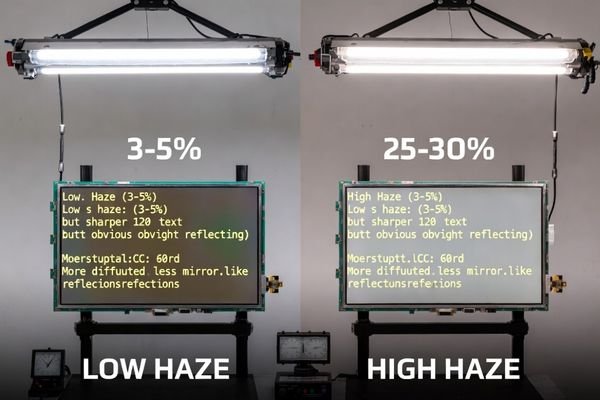
Based on my LCD display module integration work at LCD Module Pro, I have seen many projects where teams initially preferred the sharper-looking low-haze sample, only to encounter usability problems later in the field. In bright industrial lighting, near a window, or in a vehicle-like environment, the same display that looked excellent on a lab bench could become too reflective to use comfortably. The opposite can also happen: a high-haze sample may control glare well but make a high-resolution interface look softer than the application can tolerate.
That is why haze validation should be treated as an engineering verification step rather than a surface-style preference test. The correct haze choice is the one that minimizes functional failure in the target application. This article explains why haze validation1 matters, what should be compared, how to build a realistic validation method, and how to make a defensible engineering decision between clarity and anti-glare performance.
Why Is Haze Validation Important in LCD Display Module Design?
Haze validation matters because haze directly influences two performance goals that often conflict with each other: image sharpness and glare control.
Haze validation is important because it determines whether the LCD display module can maintain usable clarity while also controlling distracting reflections in the real operating environment. Without validation, a display may look sharp but fail in bright light, or reduce glare effectively while making fine content too soft to use comfortably.
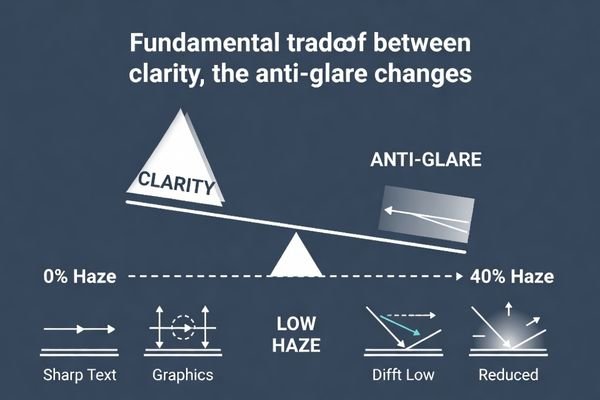
From an engineering perspective, this is a risk-control problem. A module can appear acceptable in a controlled indoor review and still fail once it is installed in the final product. That failure may show up as unreadable text, excessive reflected glare, visual fatigue, or degraded task performance. Haze validation is the process that makes this trade-off visible before the product enters production.
The Two Opposing Forces
The need for haze validation comes from two optical realities.
- Clarity: A display appears sharper when emitted light from each pixel reaches the viewer with minimal scattering. Low haze tends to preserve this direct-view sharpness.
- Anti-Glare Performance: Reflections become less distracting when incoming ambient light is scattered instead of reflected in a hard mirror-like form. Higher haze usually supports this behavior.
These two outcomes are linked by the same physical mechanism: light scattering. Higher haze can reduce reflected glare, but it can also soften fine text and graphics. Lower haze can preserve perceived sharpness, but it may create stronger reflections. Haze validation is the method used to identify the best application balance rather than assuming one optical preference is always superior.
What Exactly Should Be Compared When Evaluating Haze Trade-Offs?
A useful haze comparison is not a simple glossy-versus-matte preference check. Engineers should compare the specific performance attributes that affect task success in the target application.
When evaluating haze trade-offs, engineers should compare reflected glare severity, text legibility, fine-detail sharpness, perceived contrast under ambient light, and viewing comfort using the real content and operating conditions of the product.
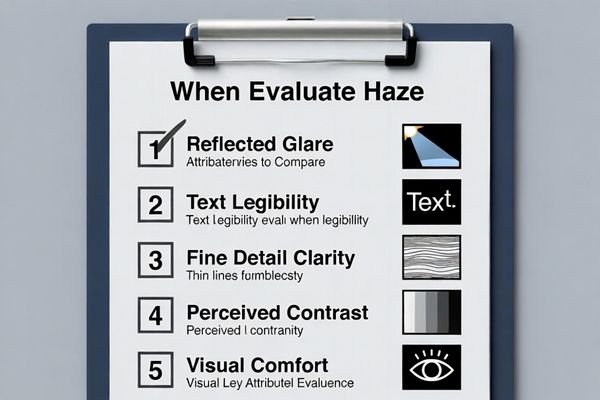
The most important question is not which sample looks better in isolation. The more useful question is which sample supports the required task more effectively once ambient light and real content are introduced.
| Attribute to Compare | Key Question | Why It Matters |
|---|---|---|
| Reflected Glare | How sharp, bright, and distracting are reflections from overhead lights or windows? | This shows how effectively the haze level controls mirror-like reflections. |
| Text Legibility | Can the smallest required text still be read at the intended viewing distance? | This reveals whether increased haze is reducing practical clarity too much. |
| Fine Detail Clarity | Are thin lines, icons, and detailed graphics still crisp enough for the task? | This helps expose haze-related softness that may not be obvious at first glance. |
| Perceived Contrast | Does the display remain visually distinct under bright ambient light? | This helps assess how haze and reflections affect usable image contrast. |
| Visual Comfort2 | Can the user observe the display for extended periods without excessive strain? | This captures the real usability result rather than only the optical appearance. |
A lower-haze sample may win in controlled viewing but still fail in real ambient light. That is why the comparison must always be tied to real task performance rather than visual preference alone.
How Should Engineers Build a Realistic Validation Method for Haze?
A valid haze test should reproduce the real optical environment as closely as possible. A simple side-by-side comparison under uncontrolled office lighting is not enough.
A realistic haze validation method should use multiple candidate samples, the final or near-final optical stack, actual UI content, and lighting conditions that represent the real use environment. Only then can engineers evaluate the true balance between clarity and anti-glare performance.
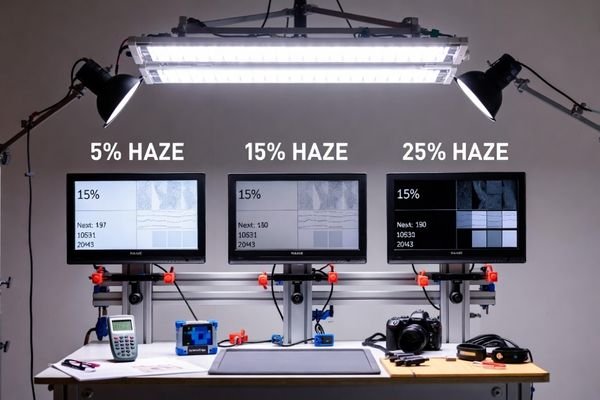
A practical method usually follows a structured sequence:
- Collect Representative Samples
Prepare display samples with different haze levels or different front-surface treatments that are realistic candidates for the project. - Use the Final Optical Stack
The final cover stack must be included in haze validation because optical structure changes the visual result. Air gap, optical bonding, cover lens thickness, surface treatment, and AR or AG layers can all change the final haze behavior. - Load Real Content
Use actual UI content, realistic text size, thin graphics, grayscale transitions, and the types of screens users will actually see in operation. - Reproduce Real Lighting
Test under the lighting conditions the product will face, such as bright office lighting, industrial overhead lighting, near-window daylight, or semi-outdoor exposure. - Observe at Real Distance and Angle
Validation should reflect actual user position, not only close-range inspection. Viewing distance and viewing angle often change the clarity-versus-glare result. - Document the Results
Record what each haze level does well and where it begins to fail, including both readability and reflected-light behavior.
This process turns haze evaluation into engineering validation instead of visual comparison. If needed, our team at info@lcdmodulepro.com can help review suitable optical stack3 combinations for this type of validation.
Which Test Conditions and Visual Criteria Help Reveal the True Trade-Off?
The true haze trade-off only becomes visible when both clarity and anti-glare performance are stressed at the same time.
The most revealing haze test conditions combine fine on-screen detail with strong ambient light. The most useful visual criteria are whether content remains readable, whether reflections are distracting, and whether the image becomes too soft for the intended task.
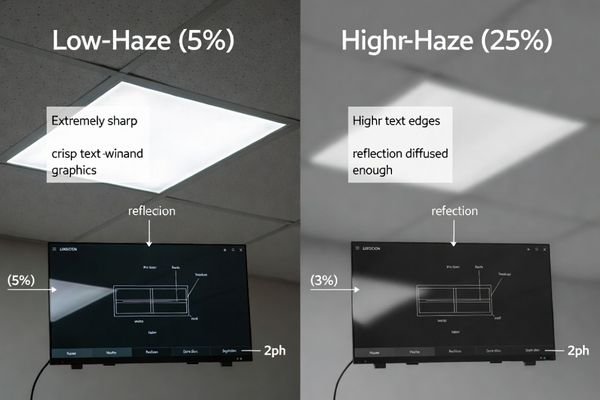
Several test combinations are especially useful:
- Fine Black Text on a Light Background
This reveals whether higher haze is reducing text sharpness too much, especially at the smallest required font size. - Thin-Line Graphics and Detailed UI Elements4
Maps, diagrams, engineering graphics, or dense control interfaces quickly expose clarity loss caused by excess diffusion. - Dark UI with Bright Ambient Reflection
Reflections are often most visible on darker content. This condition helps reveal whether glare remains too distracting. - Grayscale or Subtle Contrast Patterns
These help show whether haze and ambient light together are washing out fine tonal differences. - Longer Viewing Sessions
Short comparisons are not enough. Haze that seems acceptable initially may still create fatigue or frustration during extended use.
Higher haze can reduce glare, but it can also soften fine text and graphics. The true engineering question is whether the reduced glare improves overall usability enough to justify the loss in sharpness. That decision can only be made when both dimensions are stressed together.
How Do You Decide Which Haze Level Is the Right Engineering Choice?
The right haze level is not the one that wins a quick side-by-side comparison under ideal lighting. It is the one that best supports the product’s real operating task.
The correct haze choice is the one that provides the best functional balance between image clarity and anti-glare performance for the actual application, viewing distance, ambient light level, and user task.
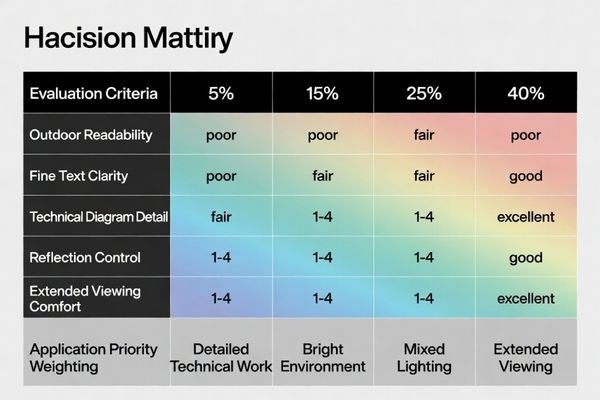
A practical decision should follow these principles:
- Prioritize the Main Use Case
Determine whether the product is mainly used for fine text reading, industrial data visibility, public information display, or mixed-light operation. The primary use case should drive the weighting of clarity and glare control. - Identify Functional Failure Points
For each haze option, identify the condition under which usability breaks down. One sample may fail because reflections dominate. Another may fail because details become too soft. - Optimize for Real Usage, Not First Impression
If the product spends most of its life in bright ambient light, a slightly softer but more readable screen may be the better engineering choice. - Evaluate the Full Stack, Not the Surface Alone
Haze should never be judged without considering the full front optical structure. - Document the Justification
The final haze decision should be recorded with a short engineering rationale tied to real test conditions and product function.
Haze validation should be based on usability under real lighting, not appearance in controlled viewing alone. The right haze level is the one that minimizes usability problems across the actual operating range of the product.
FAQ
Why can’t haze be validated just by comparing two samples indoors?
Because indoor comparison alone usually does not reproduce the real lighting, viewing distance, and usage conditions that determine whether the haze trade-off is acceptable in practice.
Does higher haze always mean better anti-glare performance?
Higher haze usually improves glare diffusion, but too much haze can reduce perceived sharpness and fine-detail clarity, so better anti-glare performance does not always mean better overall usability.
What type of content is best for haze validation?
Actual UI content, fine text, thin lines, grayscale patterns, detailed graphics, and high-contrast elements are all useful because they reveal both clarity loss and glare-related readability issues.
Should haze be validated with the final cover stack?
Yes. Haze performance can change significantly depending on cover lens design, surface treatment, air gap, and optical bonding.
Can users prefer a lower-haze sample even if it performs worse in bright light?
Yes. A lower-haze sample may appear sharper in controlled viewing, which is why validation must be based on real application conditions rather than first impression.
What is the main goal of haze trade-off validation?
The main goal is to identify which haze level delivers the best usable balance between clarity and anti-glare performance in the intended environment.
Conclusion
You validate haze trade-offs on an LCD display module by comparing real content, real lighting, and real optical stack performance instead of relying on first visual impression. The purpose of haze validation is not to decide whether glossy or matte appearance looks more attractive, but to determine which haze level supports the best usable balance between image clarity and anti-glare behavior.
At LCD Module Pro, we recommend treating haze validation as a structured engineering process. When engineers use realistic content, final optical structure, target lighting conditions, and task-based comparison, they are much more likely to choose an LCD display module that performs well in real use rather than only appearing attractive in a controlled comparison.
✉️ info@lcdmodulepro.com
🌐 https://lcdmodulepro.com/
-
Understanding haze validation is crucial for making informed decisions in display module integration, ensuring optimal performance in real-world conditions. ↩
-
Exploring visual comfort can reveal insights into prolonged usage and user satisfaction, essential for display design. ↩
-
Learn about optical stacks to grasp how they influence display quality and performance. This resource will deepen your understanding. ↩
-
This resource will help you understand the importance of clarity in UI design, especially for complex graphics. ↩