Choosing an LCD module supplier is one of the most important decisions in an equipment development project. The supplier you select can affect more than unit price and delivery time. It can influence sample development, interface compatibility, mechanical integration, brightness performance, touch reliability, quality consistency, long-term supply, and future redesign risk.
Selecting the right LCD module supplier is a project-level decision. A suitable supplier should be evaluated by project fit, engineering support, customization capability, validation process, communication quality, and long-term supply stability—not price alone.
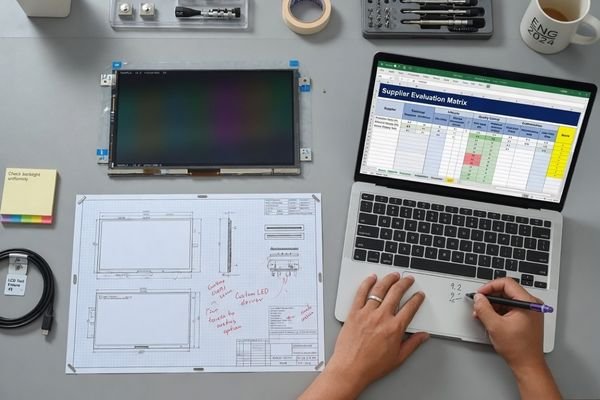
For equipment manufacturers, an LCD module should not be treated as a simple commodity component1. It is a functional subsystem that must match the host device, application environment, mechanical structure, electrical interface, power conditions, touch requirements, and lifecycle expectations.
This article provides a practical framework for choosing an LCD module supplier for standard, modified, or custom display projects. It focuses on what equipment developers should evaluate before selecting a supplier, what risks to avoid, and what information should be prepared before starting a supplier discussion.
LCD Module Pro approaches supplier evaluation from a project-fit perspective. Before recommending a display module direction, the project application, module configuration, engineering constraints, customization scope, and lifecycle expectations should be reviewed together.
Why Supplier Selection Matters in LCD Module Projects
Choosing a supplier for an LCD module project affects the entire development process. A supplier may influence early feasibility review, sample development, mechanical fit, interface matching, optical performance, power compatibility, touch function, production consistency, and long-term replacement planning.
The right LCD module supplier acts as a project support resource, not only a source of display hardware. Their value should be measured by how well they reduce integration risk and support the final product lifecycle.
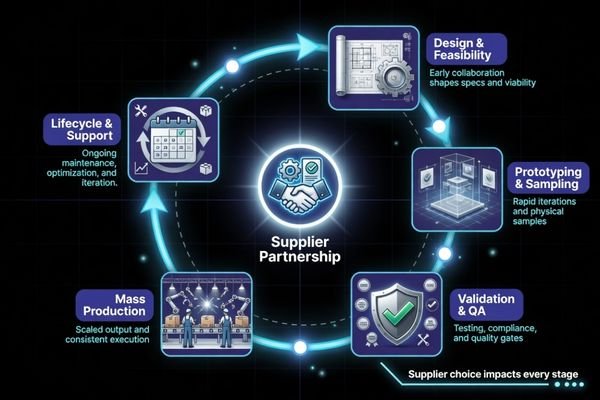
In project-based LCD module sourcing, early supplier involvement can help identify mechanical, electrical, optical, and lifecycle risks before samples are produced. If the supplier only provides a part number and quotation, important details may be missed.
For example, a display module may meet the size and brightness requirement but still fail to fit the enclosure because the FPC direction conflicts with the internal structure. Another module may work during a bench test but create issues later because the interface, power requirement, or backlight load was not reviewed against the host system.
A capable supplier should help the customer evaluate these risks before the project reaches tooling, sample approval, or mass production. This is why supplier selection should be treated as part of the engineering decision process, not only as a purchasing activity.2
Start by Defining Your Project Requirements
Before comparing LCD module suppliers, the project requirements should be defined as clearly as possible. A vague inquiry usually leads to vague proposals, while a clear project brief allows suppliers to judge whether a standard, modified, or custom LCD module is most suitable.
A clear project requirement list is the starting point for supplier evaluation. Without it, customers cannot accurately compare supplier proposals or confirm whether the recommended module fits the application.
A strong project definition3 should include:
- screen size
- resolution
- brightness target
- viewing direction or viewing angle requirement
- interface type
- touch requirement
- cover glass requirement
- optical bonding requirement
- operating temperature
- storage temperature
- indoor or outdoor use
- mechanical constraints
- enclosure drawing
- expected quantity
- product lifecycle
- certification or validation plan
- target development schedule
These details help the supplier understand the real project conditions. They also make it easier to identify whether the project can use an existing module, a modified module, or a custom-developed LCD module.
If a supplier gives a recommendation without asking about the application, interface, mechanical structure, operating environment, or lifecycle, the proposal may be based only on a catalog match rather than a project-fit evaluation.
Check Whether the Supplier Understands Your Application
Different applications require different LCD module solutions. A display used in an indoor control panel is not the same as a display used in outdoor equipment, marine systems, transportation displays, industrial terminals, kiosks, or embedded devices.
A suitable supplier should understand the application environment before recommending an LCD module. A supplier that quotes only by size and price may miss important requirements related to brightness, temperature, touch operation, vibration, mounting, and long-term supply.
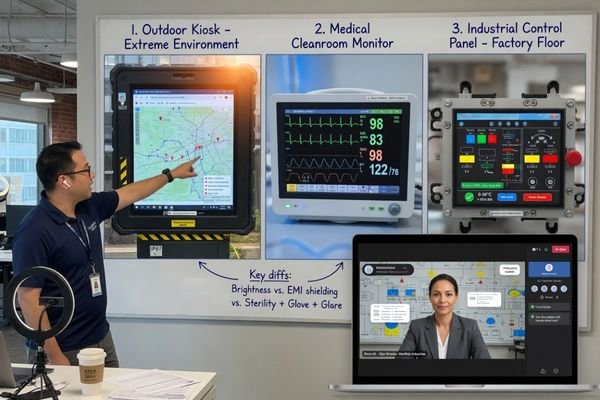
Application understanding affects the entire display selection process. For example:
- Outdoor terminals may require high brightness, optical bonding, AG/AR treatment, and thermal review.
- Marine or port equipment may require sunlight readability, moisture consideration, vibration resistance, and long lifecycle planning.
- Transportation displays may require stable operation, wide viewing angles, vibration tolerance, and long-term availability.
- Industrial control panels may require mechanical fit, interface stability, touch reliability, and consistent supply.
- Embedded devices may require compact size, low power consumption, interface compatibility, and stable integration.
A supplier that understands the application will ask questions about where and how the display will be used. This is important because the same screen size can require very different module configurations depending on the final product environment.
For application-based projects, customers can also review display solutions for industrial equipment to understand how LCD module requirements change across different use cases.
Evaluate Engineering Support, Not Just Product Catalogs
A large product catalog does not necessarily mean strong project support. For industrial and custom LCD module projects, engineering support is often more important than the number of standard models a supplier can list.
A strong LCD module supplier should be able to support engineering review, not only product selection. Interface, power, backlight, touch, mechanical fit, FPC direction, connector position, optical bonding, thermal behavior, and host system compatibility should be evaluated together.
A supplier with real project support capability should be able to review:
- interface type, such as LVDS, eDP, MIPI, HDMI, RGB, or other project-specific interfaces
- input power and backlight power requirements
- power sequencing and control signals
- brightness and thermal behavior
- touch panel and cover glass structure
- optical bonding and surface treatment
- FPC direction and cable routing
- connector position
- module outline and mounting method
- host board compatibility
- enclosure constraints
- lifecycle and replacement risk
This type of review can prevent problems that may not appear during basic module selection. A supplier may have a matching size in the catalog, but that does not guarantee the display can be integrated into the customer’s device without modification.
LCD Module Pro usually reviews brightness, interface, touch, power, mechanical constraints, FPC direction, cover glass, bonding, and host system requirements before confirming whether a standard, modified, or custom module is more suitable.
For projects that require deeper integration support, custom LCD module engineering can help evaluate module feasibility before the design is locked.
Confirm Customization Capability and Project Fit
Many LCD module projects require some level of customization. However, customization should be based on real project needs, not used as the default answer for every inquiry.
A good LCD module supplier should understand when to use a standard module, when to modify an existing module, and when a custom solution is technically and commercially justified.
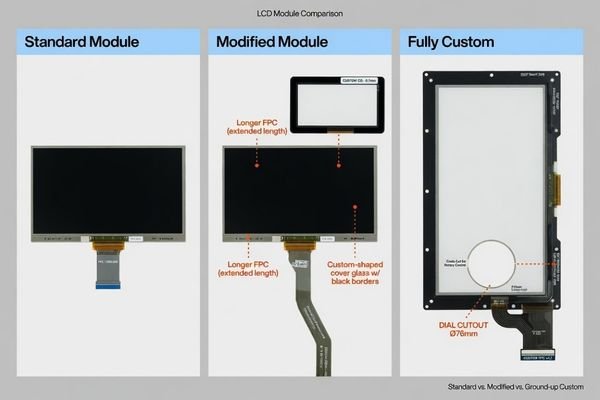
Customization capability may include:
- custom cover glass
- PCAP or resistive touch integration
- optical bonding
- high-brightness backlight
- AG, AR, or anti-smudge surface treatment
- wide-temperature support
- interface board design
- controller board integration
- FPC direction adjustment
- connector position adjustment
- custom cable design
- mechanical outline modification
- mounting structure adjustment
- power design modification
- lifecycle and replacement planning
However, not every project needs a fully custom module. Full customization may involve higher development cost, longer lead time, additional validation, and minimum order requirements. In many cases, a standard module with selected modifications can meet the project requirements more efficiently.
A suitable supplier should explain the trade-offs between standard, modified, and custom module options. This helps the customer avoid both under-specification and unnecessary over-customization.
Customers can compare available industrial LCD module options before deciding whether a standard module, modified module, or custom LCD module is the right direction.
Review Quality Control and Validation Process
A working sample is important, but it is not enough. A reliable LCD module supplier should have a clear sample confirmation and production consistency process so that production units remain aligned with approved specifications.
Supplier evaluation should focus on production consistency, not only sample success. The goal is to reduce variation between prototype samples and mass production units.
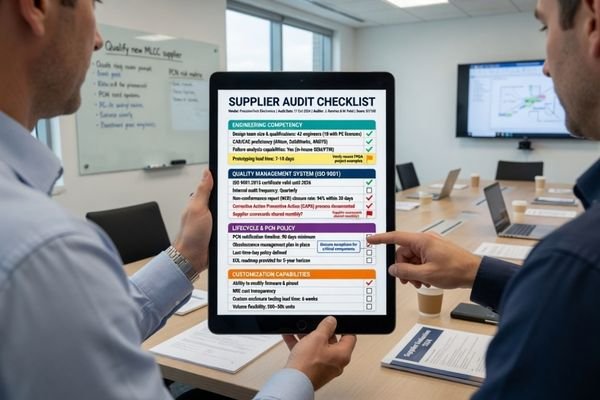
A customer should understand how the supplier manages quality before sample approval and production. Important areas may include:
- incoming material inspection
- LCD panel inspection
- appearance and cosmetic inspection
- electrical performance testing
- brightness and uniformity checks
- touch function validation
- optical bonding inspection
- interface stability testing
- power consumption testing
- aging or reliability-related checks4 where applicable
- outgoing inspection
- project-specific verification
The exact validation process may vary by product type, application environment, and customer requirement. The important point is that the supplier should be able to explain how the approved sample will be controlled during production.
A strong supplier should also be clear about what is tested on every unit, what is tested by sample batch, and what requires additional project-specific validation. This transparency helps customers understand both capability and limitation.
Consider Long-Term Supply and Change Control
Industrial equipment usually has a longer lifecycle than consumer electronics. A display selected during product development may need to remain available for years of production, maintenance, and spare part support.
Long-term supply and change control are critical in LCD module projects because panel discontinuation, interface changes, backlight changes, or mechanical changes may cause redesign, revalidation, and maintenance risk.
For industrial applications, customers should ask suppliers about:
- expected panel availability
- lifecycle planning
- replacement strategy
- specification consistency
- change notification process
- PCN or ECN procedure
- alternative module planning
- spare part support
- last-time-buy communication where applicable
- compatibility of future replacements
Instead of asking for an unconditional “guaranteed availability period,” it is more practical to ask about the expected availability or lifecycle plan for the proposed LCD panel. LCD supply can be affected by panel manufacturer decisions, market demand, upstream materials, and production strategy.
A supplier that works with industrial projects should be able to discuss lifecycle risk before the module is selected. When exact drop-in replacement is not possible, the supplier should help evaluate functionally compatible replacement options where possible.
Compare Communication Quality and Technical Response
Communication quality can directly affect sample development, issue tracking, risk identification, and project speed. The supplier’s response during the inquiry stage often reveals how they may support the project later.
A strong LCD module supplier communicates with technical clarity. They ask relevant questions, identify risks early, explain limitations, and provide practical recommendations instead of only sending a quotation.
When comparing suppliers, customers should evaluate the quality of the technical conversation, not only the price.
| Supplier Response | What It May Indicate |
|---|---|
| Only provides price and lead time | Weak project understanding or limited technical involvement. |
| Asks about application environment | Better ability to match the module to real use conditions. |
| Reviews drawings or datasheets | Stronger mechanical and electrical integration support. |
| Explains risks and trade-offs | More reliable technical communication. |
| Gives unclear or inconsistent answers | Possible coordination problems between sales and engineering. |
| Promises everything without review | Possible overclaim risk. |
| Provides practical next steps | Better project management and supplier reliability. |
A supplier that asks the right questions may take slightly longer to respond at the beginning, but the result is often a more accurate recommendation. Fast quotation is useful, but fast quotation without technical review can create downstream risk.
Red Flags When Choosing an LCD Module Supplier
Certain warning signs can indicate that a supplier may not be suitable for a project-based LCD module program. These red flags are especially important when the project requires customization, engineering support, or long-term supply stability.
A supplier relationship built only on low price can become risky if the supplier lacks technical depth, quality control, lifecycle planning, and clear communication.
Common red flags include:
- Focusing Only on Price: The supplier immediately discusses unit cost without understanding the application, environment, or integration requirements.
- Avoiding Technical Questions: The supplier cannot answer questions about interface, power, touch, thermal behavior, or mechanical constraints.
- No Clear Datasheet or Drawing Support: The supplier cannot provide or review basic drawings, interface definitions, or module specifications.
- Unclear Lifecycle Information: The supplier cannot explain expected panel availability, replacement planning, or change notification.
- No PCN or ECN Process: The supplier has no clear process for communicating changes in components, structure, specifications, or production conditions.
- Overpromising Customization: The supplier claims to support everything without asking for detailed requirements or explaining limitations.
- Unclear NRE or MOQ Requirements: The supplier does not clearly explain development cost, tooling cost, sample cost, or minimum order expectations.
- No Defined Sample Revision Process: The supplier cannot explain how sample changes, feedback, and approval will be handled.
- No Clear Quality Process: The supplier cannot describe sample confirmation, production inspection, or outgoing quality control.
- Sales Promises Without Engineering Confirmation: The supplier confirms feasibility before engineering review.
- Slow or Vague Communication: Responses are delayed, generic, or fail to address the customer’s specific questions.
Not every red flag means the supplier is unusable. However, if several of these signs appear together, the customer should be cautious before committing the project.
What to Prepare Before Contacting an LCD Module Supplier
A productive supplier discussion starts with clear project information. The more complete the project brief is, the easier it is for the supplier to evaluate feasibility, recommend the right module direction, and identify risks early.
Before contacting an LCD module supplier, customers should prepare enough technical, mechanical, environmental, and commercial information to support accurate evaluation.
| Information to Prepare | Why It Helps the Supplier |
|---|---|
| Screen Size | Helps identify suitable LCD panel and module options. |
| Resolution | Confirms image quality, interface bandwidth, and host compatibility. |
| Brightness Target | Determines backlight design, thermal direction, and outdoor readability. |
| Interface Type | Confirms compatibility with the host board. |
| Touch Requirement | Defines touch panel type, cover glass, bonding, and controller needs. |
| Mechanical Drawing | Helps check outline size, FPC direction, connector position, and mounting. |
| Operating Environment | Defines brightness, temperature, vibration, moisture, and durability needs. |
| Cover Glass Requirement | Supports mechanical protection, touch integration, and surface treatment decisions. |
| Optical Bonding Requirement | Helps evaluate visibility, structure, and environmental resistance. |
| Expected Quantity | Helps evaluate standard, modified, or custom module direction. |
| Lifecycle Expectation | Supports long-term supply and replacement planning. |
| Certification Plan | Helps align module design with final equipment validation requirements. |
| Project Schedule | Helps evaluate sample timing, development path, and production planning. |
When customers provide this information early, LCD Module Pro can perform a more accurate module-level review and recommend whether the project is better suited for a standard module, a modified module, or a custom LCD module solution.
Common Questions About Choosing an LCD Module Supplier
How should I evaluate an LCD module supplier?
A suitable LCD module supplier should be evaluated by engineering support, customization capability, application understanding, quality process, communication quality, long-term supply stability, and change control, not only by price or delivery time.
Is the lowest-priced LCD module supplier the best choice?
The lowest price is not always the best choice. A low-cost module may increase redesign, validation, lifecycle, quality, or after-sales risk if the supplier cannot support the full project requirements. The total project cost should be considered, not only the unit price.
When do I need a custom LCD module supplier?
A custom LCD module supplier may be needed when standard modules cannot match the required brightness, interface, touch function, mechanical structure, operating environment, supply lifecycle, or system integration requirements.
What information should I send to an LCD module supplier?
Useful information includes display size, resolution, brightness, interface type, touch requirement, mechanical drawing, operating environment, quantity, lifecycle expectation, certification plan, and target schedule. These details help the supplier evaluate the correct module direction.
How can I compare two LCD module suppliers?
Two suppliers should be compared by technical response quality, application understanding, customization scope, sample process, validation method, supply stability, change control, and communication efficiency, not only by quotation.
Choosing the Right LCD Module Supplier Starts with Project Fit
Choosing the right LCD module supplier should start with project fit. The best supplier is not always the lowest-priced or fastest-quoting option. It is the supplier that can understand the application, match technical requirements, support engineering review, manage customization scope, maintain quality consistency, and reduce long-term supply risk.
For project-based LCD module sourcing, customers should evaluate more than price. Application understanding, engineering support, customization capability, sample validation, production consistency, lifecycle planning, and communication quality all affect the final result.
LCD Module Pro supports equipment manufacturers with module-level review for standard, modified, and custom LCD module projects. The review may include display size, resolution, brightness, interface, touch, cover glass, bonding, power, mechanical constraints, application environment, quantity, lifecycle, and validation requirements.
Need help evaluating the right LCD module for your project?
Share your display size, resolution, brightness target, interface, touch requirement, mechanical drawing, operating environment, quantity, and lifecycle expectation with our team for a module-level review.
Send Your LCD Module Requirements
✉️ info@lcdmodulepro.com
🌐 https://lcdmodulepro.com/
-
"Touch Integration for LCD Modules in Equipment Design", https://lcdmodulepro.com/engineering-technology/touch-integration-for-lcd-display-modules/. This source explains that LCD modules should be considered as part of the full equipment system, not as simple commodity parts. Scope note: Integration practices vary by application, vendor, and product requirements. ↩
-
"Supplier selection and order lot sizing modeling: A review", https://www.sciencedirect.com/science/article/abs/pii/S0305054806000153. This review shows that supplier selection is closely linked to cost, quality, performance, and supply planning. This supports treating LCD supplier choice as an engineering and procurement decision. Scope note: The study is about general supplier selection, not LCD modules specifically. ↩
-
"ISO 21500:2012 – Guidance on project management", https://www.iso.org/standard/50003.html. ISO project management guidance supports defining project requirements clearly before execution. This supports preparing detailed LCD project specifications, including size, resolution, brightness, interface, touch, environment, mechanics, lifecycle, quantity, and schedule. Scope note: The standard is general project guidance, not an LCD-specific checklist. ↩
-
"Complete Guide to PCB Aging Test Methods for Electronics", https://resources.altium.com/p/pcb-aging-test. This technical guide explains aging and reliability tests used to evaluate electronic products under stress conditions. This supports including reliability checks in LCD supplier quality evaluation. Scope note: Actual test items and conditions depend on the product, manufacturer, and application. ↩