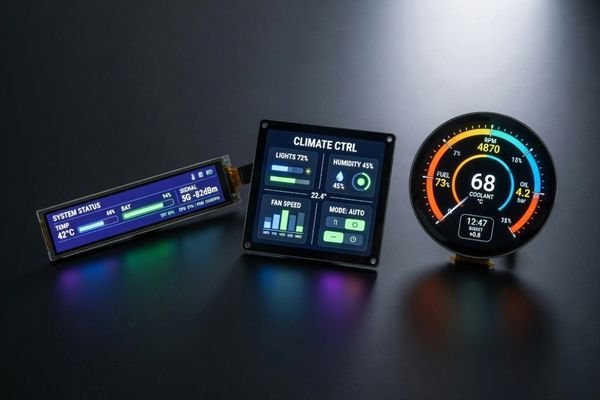
The demand for custom-shaped LCD modules is increasing as equipment designers look for display formats that fit fixed spaces, non-standard front panels, and application-specific information layouts. Bar type, square, round, and ultra-wide LCD modules can all be useful, but the shape itself is only one part of the decision.
In this article, “custom-shaped LCD modules” refers to LCD display modules for device integration, not finished monitors or complete display systems.
Successfully integrating a custom-shaped LCD module requires a design approach that starts with the device function and installation space. Key considerations include UI layout, aspect ratio, resolution, interface timing, mechanical integration, optical structure, touch, cover glass, MOQ, and lifecycle planning before the module is finalized.
In custom LCD module projects, the most common mistake1 is treating a non-standard display format as a simple replacement for a rectangular module. That can lead to a cramped UI, distorted content, FPC interference, poor active-area alignment, or sourcing problems later in the product lifecycle.
The better question is not only “What shape do we want?” but “What shape does the application actually need?” The LCD module format should support the information being displayed, the available mechanical space, the host controller output, and the structure around the display.
Start With the Device Function and Installation Space
The decision to use a custom-shaped LCD module should be anchored in the device requirement. Before choosing a bar type, square, round, ultra-wide, or other non-standard module, the first step is to review the application, front-panel layout, and enclosure constraints.
The shape of a custom-shaped LCD module should be driven by device function and available space, not by appearance alone. A practical review should include the front-panel opening, viewing distance, UI content, operating environment, internal clearance, and mechanical structure.
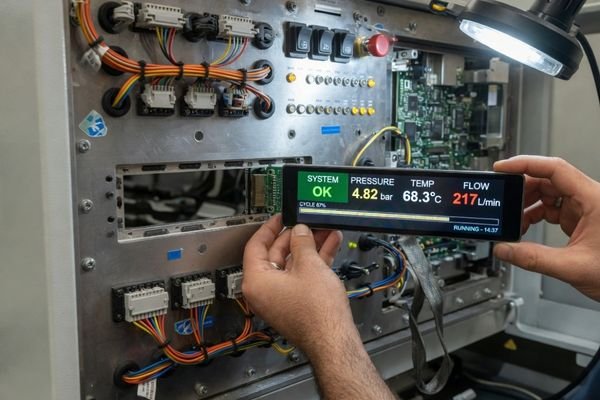
In custom-shaped LCD module reviews, our engineering team usually starts by checking the available installation space, target visible area, viewing distance, UI content, interface output, FPC direction, and mounting structure before recommending a display shape. These details help determine whether the project can use an available special-shaped LCD module or needs deeper module-level customization.
For applications such as transportation systems, smart retail devices, industrial control panels, and outdoor terminals, the LCD shape should be selected around the real device function and installation space.
Analyzing the Installation Space
The physical envelope is often the first constraint. A long and narrow area on a control panel may be suitable for a bar type LCD module. A compact front surface may work better with a square LCD module. A circular opening, knob interface, or gauge-style design may require a round LCD module.
Mechanical constraints should be documented early, including front-panel opening, available depth, mounting area, connector position, FPC direction, cable route, and internal clearance. These details often decide whether an existing special-shaped LCD module can be used directly.
Defining the Functional Requirements
The next question is what the display must show. Status information, route messages, gauge values, menu controls, and multi-zone content do not use screen space in the same way.
A bar type LCD module may fit linear information well, but it may not suit a complex graphical interface. A square LCD module can support a more balanced layout. A round LCD module may work better for radial or gauge-like information.2 The display shape should follow the information structure.
Match Display Shape With UI Layout and Aspect Ratio
A custom-shaped LCD module only works well when the UI is designed around its real shape and aspect ratio. Forcing a standard 16:9 interface onto a bar type, round, or square module often creates poor results.
Display shape and UI layout should be reviewed together. A custom-shaped LCD module may look suitable in the product concept, but it can still fail if the content cannot use the active area efficiently or the aspect ratio does not match the user workflow.
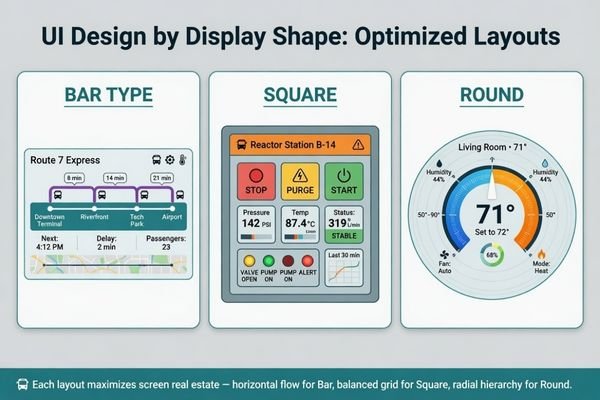
Before confirming the display shape, we usually ask for sample UI content or a rough layout. Status bars, gauge values, route information, menu controls, and multi-zone content may require different aspect ratios and pixel arrangements. A display shape that looks attractive in the product concept may still fail if the UI cannot use the active area efficiently.
| LCD Module Shape | Suitable Use Case | Design Risk to Review |
|---|---|---|
| Bar Type LCD Module | Status bars, shelf displays, ticketing information, transportation data | UI compression, cable routing, backlight uniformity3 |
| Square LCD Module | Control panels, dashboards, compact smart terminals | UI scaling, interface bandwidth, mounting space |
| Round LCD Module | Gauges, knobs, appliance interfaces, circular windows | Active area alignment, cover glass shape, touch area |
| Ultra-Wide LCD Module | Multi-zone information in narrow spaces | Resolution mapping, signal timing, mechanical length |
| Custom Module Structure | Fixed front-panel windows or special enclosure needs | MOQ, tooling, validation, lifecycle |
The UI and LCD aspect ratio should be reviewed before module selection. This reduces the risk of choosing a visually attractive shape that later becomes difficult to use, difficult to drive, or inefficient for the actual content.
Review Resolution, Interface, and Signal Timing Early
Non-standard LCD modules often come with non-standard resolutions, aspect ratios, pixel mapping, and signal timing. These electrical details should be reviewed with the host controller before prototype development.
A custom-shaped LCD module is not only a mechanical decision. Native resolution, controller output, interface bandwidth, timing compatibility, scaling behavior, and driver board requirements should be checked early to avoid distorted images, flicker, unstable output, or no image.
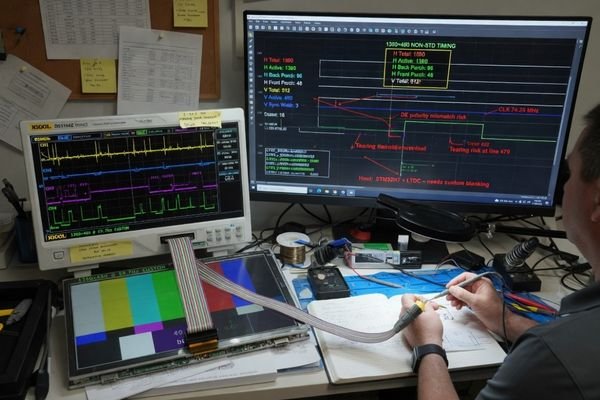
For non-standard LCD module formats, our engineering review usually checks native resolution, controller output, interface bandwidth, signal timing, scaling behavior, and driver board requirements before prototype development. This helps avoid problems such as stretched images, unstable output, flicker, or no image after the module is connected to the host system.
A standard controller board may be optimized for common formats such as 1920×1080 or 1280×800. A bar type, square, round, or ultra-wide LCD module may need different output settings, different image mapping, or a dedicated driver board.
| Issue | What Can Go Wrong | What to Check |
|---|---|---|
| Non-standard resolution | Image distortion or unsupported output | Host output and native resolution |
| Aspect ratio mismatch | UI stretched, cropped, or poorly arranged | UI canvas and pixel mapping |
| Interface bandwidth | Flicker or unstable signal | LVDS, eDP, MIPI, or RGB capability |
| Timing compatibility | No image or unstable display | Panel timing and controller support |
| Driver board requirement | Extra cost, space, and validation work | HDMI/eDP/LVDS conversion path |
A custom-shaped LCD module project should not move to prototype only because the shape fits mechanically. The signal path also needs to be realistic.
Check Mechanical Integration for Non-Standard Shapes
The outline of a special-shaped LCD module often requires earlier mechanical review than a standard rectangular module. A display may look suitable from the front, but real integration depends on the connector, FPC, cable route, cover glass window, thickness, and mounting structure.
Mechanical integration of a custom-shaped LCD module should include module outline, active area, viewing area, cover glass window, mounting method, connector position, FPC direction, and cable routing in relation to the device enclosure.
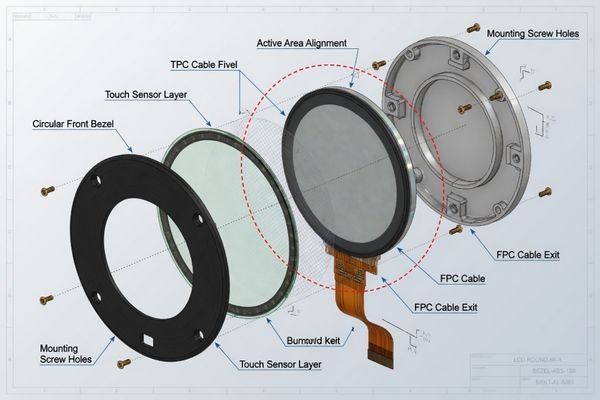
In mechanical integration reviews, the first risk points usually appear around the FPC exit direction, connector access, front-panel opening, and active-area alignment. These details may look minor in drawings, but they can affect assembly, serviceability, and final appearance.
Connector and Cable Management
The FPC exit direction and cable length are critical. If the cable exits toward a structural wall, screw boss, battery, heat source, or other internal part, it can create stress or assembly difficulty.
The cable route should allow a safe bend radius and a clear path to the mainboard connector. Connector access also matters. If the connector is difficult to reach, production assembly and service may become slower or less reliable.
Alignment of Active and Viewing Areas
For special-shaped LCD modules, the active area, viewing area, cover glass window, and enclosure opening should be reviewed together. The active area is the pixel display region. The viewing area and cover glass window define what the user actually sees after assembly.
If these areas are not aligned4, the front panel may cover useful pixels, expose unwanted bezel areas, or make the display look off-center. This is especially important for round LCD modules, bar type LCD modules, and modules with rounded corners.
Plan Touch, Cover Glass, and Optical Bonding Together
For many modern devices, the LCD module becomes part of a front-panel assembly that includes PCAP touch, cover glass, optical bonding, decorative printing, coating, and sealing structures.
Touch, cover glass, and optical bonding should be planned as part of the custom-shaped LCD module stack, not as accessories added after the display format is fixed. They affect thickness, visible area, touch response, optical performance, FPC routing, and assembly tolerance.
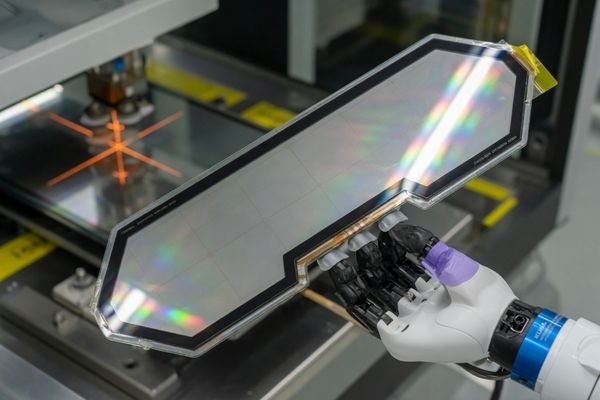
A bar type LCD module may require a long and narrow cover glass. A round LCD module may need a circular viewing window and carefully aligned touch area. A square LCD module may require balanced black border printing and clean edge alignment.
The touch FPC and LCD FPC should be checked together to avoid routing conflicts. Cover glass thickness, edge treatment, black border printing, and mechanical tolerance can all affect assembly quality and final appearance.
Optical bonding can improve readability and structural stability, especially for outdoor or high-brightness applications, but it may also affect thickness, serviceability, and rework strategy. Explore high brightness display modules when your custom-shaped LCD project also requires outdoor readability, optical bonding, cover glass integration, or sunlight-readable performance.
Evaluate Customization Feasibility, MOQ, and Lifecycle
“Custom-shaped” does not always mean fully free-form LCD glass. In many industrial LCD module projects, the practical path is to evaluate available special-shaped LCD platforms first, then customize the module structure, brightness, cover glass, touch, cable, or interface around a feasible base.
Customization feasibility should be reviewed before the design direction is fixed. Available panel platforms, module-level customization options, tooling needs, expected quantity, validation plan, and lifecycle risk often determine the most practical development path.
Before confirming a custom-shaped LCD module path, our engineering review usually compares available panel platforms, module-level customization options, expected quantity, tooling needs, validation plan, and lifecycle risk. In many projects, using an existing special-shaped LCD platform and customizing the touch, cover glass, brightness, cable, or interface is more practical than starting from fully custom LCD glass.
| Customization Level | Typical Scope | Key Risk |
|---|---|---|
| Existing special-shaped LCD module | Select available bar, square, round, or ultra-wide module | Size, resolution, or interface may not fully match |
| Module-level customization | Brightness, touch, cover glass, bracket, cable, interface | Feasibility, validation, and lead time must be reviewed |
| Full custom panel development | New LCD glass or deeper panel-level design | High NRE, MOQ, long development time, supply risk |
The best starting point is often available resources. If a suitable bar type, square, round, or ultra-wide LCD platform already exists, the project can focus on customizing brightness, touch, cover glass, mechanical bracket, interface board, or driver support.
Lifecycle also matters. A custom-shaped LCD module may stay in a product for several years, so long-term supply, EOL risk, replacement options, expected quantity, validation plan, and production schedule should be reviewed before design freeze.
Discuss your custom display project before finalizing the display shape, resolution, interface, and mechanical structure.
Custom-Shaped LCD Module FAQ
What is a custom-shaped LCD module?
A custom-shaped LCD module usually refers to an LCD display module with a non-standard format, such as bar type, square, round, ultra-wide, or a module-level customized structure. It does not always mean fully custom LCD glass.
Can LCD modules be made in any shape?
Not always. Fully custom LCD glass is possible only in selected projects and usually requires higher NRE, MOQ, tooling, longer development time, and supply chain review. For many projects, using an existing special-shaped LCD module and customizing the touch, cover glass, brightness, structure, or interface is more practical.
What shapes are commonly available for special-shaped LCD modules?
Common options include bar type LCD modules, square LCD modules, round LCD modules, ultra-wide LCD modules, and other non-standard aspect ratio modules, depending on available panel resources and project requirements.
Does a custom-shaped LCD module affect interface or resolution?
Yes. Non-standard shapes often come with non-standard resolution, aspect ratio, pixel mapping, and timing requirements. Interface bandwidth and controller compatibility should be reviewed before prototype development.
Can touch and cover glass be customized for special-shaped LCD modules?
Yes, in many projects. However, touch area, cover glass thickness, printing border, optical bonding, FPC direction, and mechanical tolerance should be reviewed together.
What information is needed for a custom-shaped LCD module project?
Useful information includes the application, target shape, display size, resolution, interface, mechanical drawing, cover glass requirement, touch requirement, brightness target, expected quantity, validation plan, and production schedule.
What is the best way to start a custom-shaped LCD module project?
The best starting point is to share the application, target shape, mechanical drawing, display size, resolution, interface, brightness target, touch and cover glass requirements, expected quantity, and production schedule. This allows the engineering team to evaluate whether an existing special-shaped LCD module can be used or whether deeper customization is required.
Conclusion
Custom-shaped LCD modules can help devices fit fixed spaces, support clearer UI layouts, and create differentiated product designs. However, the display shape should be reviewed together with aspect ratio, resolution, interface, signal timing, mechanical integration, touch, cover glass, optical bonding, MOQ, and lifecycle.
Not sure which custom-shaped LCD module fits your device? Start by preparing your application, target shape, display size, resolution, interface, mechanical drawing, cover glass requirement, touch requirement, brightness target, expected quantity, and production plan. Our engineering team can help review the feasibility before the module is finalized.
→ Start your custom-shaped LCD module project
✉️ info@lcdmodulepro.com
🌐 https://lcdmodulepro.com/
-
Phoenix Display. “Common Mistakes When Integrating LCD Displays in Electronic Product Manufacturing.” ↩
-
CDTech Display. “Why the Round Display Panel Is Revolutionizing Product Design.” ↩
-
Hua Xian Jing. “How Do You Achieve Uniform Backlight Side LEDs?.” ↩
-
LCD Module Pro. “How to Determine If a Line Defect on an LCD Module Is Abnormal.” ↩