Transportation equipment often leaves only long, narrow mechanical spaces for a display. At the same time, the screen still needs to show route names, station information, warning messages, operating status, and passenger guidance clearly. A standard 16:9 LCD module may waste vertical space or force the UI into an awkward layout. This is where ultra-wide LCD modules, also called bar type LCD modules or stretched LCD modules, become useful for equipment designers and system integrators.
Ultra-wide LCD modules are used in transportation equipment because they fit narrow installation spaces and support horizontal information layouts such as route maps, station lists, service alerts, and vehicle status. They solve real mechanical space and information-layout problems, not just visual design preferences.
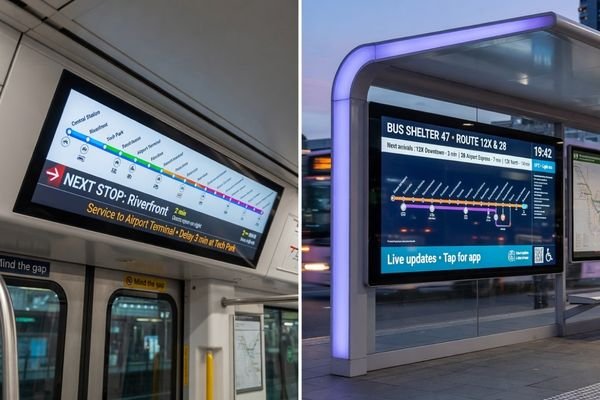
In transportation LCD module projects, the display format is often decided by the available mounting space before electrical specifications are discussed. A standard LCD module may have enough resolution, but it may not fit above a vehicle door, inside a cabin panel, or along a narrow station information strip. An ultra-wide LCD module can match these spaces more naturally while keeping important information readable1.
This article focuses on LCD modules for transportation equipment integration. It does not discuss complete passenger information systems or finished signage equipment. The goal is to explain where ultra-wide LCD modules are useful, what engineering factors should be reviewed, and how to reduce integration risk before prototype development.
Why Transportation Equipment Uses Ultra-Wide LCD Modules
Transportation equipment uses ultra-wide LCD modules because both space and information flow are constrained. In buses, trains, metro systems, stations, ticketing devices, and vehicle terminals, the available front-panel area is often long and narrow. The information itself is also usually linear: routes, station names, next-stop messages, alerts, timing data, and operating status.
A bar type LCD module can use available horizontal space more efficiently than a standard 16:9 module in narrow transportation equipment. It helps keep display height controlled while giving enough width for route, station, and status information.
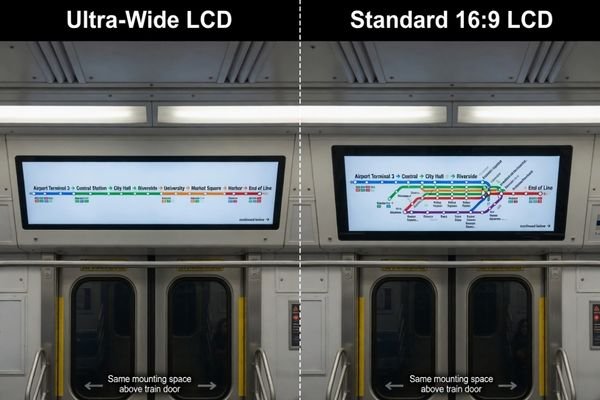
In transportation display module reviews, our engineering team usually starts by checking the available installation strip, target visible area, viewing distance, UI content, interface output, and mounting structure before recommending an ultra-wide LCD format. These details help determine whether a bar type LCD module is truly suitable, rather than simply choosing it because it looks visually different.
For applications such as transportation systems, smart terminals, public information equipment, and vehicle-mounted devices, the display format should be selected around the real installation space and user workflow.
Solving Mechanical and Spatial Constraints
In a bus or train car, the best location for a route display may be above doors, above windows, or along a narrow control panel. These areas usually do not have enough height for a standard 16:9 LCD module2. A stretched LCD module can use the available horizontal space without forcing major changes to the equipment structure.
This matters because the display is only one part of the device. The module must also leave space for the enclosure, mounting points, FPC cable, connector, mainboard, cover glass, and any front-panel structure.
Optimizing Information Layout
Ultra-wide LCD modules are also useful because transportation information is often sequential. Route maps, station lists, next-stop messages, transfer guidance, and service alerts usually follow a left-to-right flow.
On a standard 16:9 LCD module, this content may require scrolling, page switching, or crowded multi-line formatting. On an ultra-wide LCD module, more information can be shown in one continuous view, which can improve readability and reduce unnecessary UI transitions.
Passenger Information and Route Display Applications
Passenger information and route display equipment is one of the most common application areas for ultra-wide LCD modules. In buses, trains, metro systems, and station facilities, passengers need information that is easy to find, quick to understand, and readable from different positions.
Ultra-wide LCD modules are suitable for route maps, next-stop information, service updates, transfer guidance, safety messages, and compact status panels because these content types naturally fit a horizontal layout.
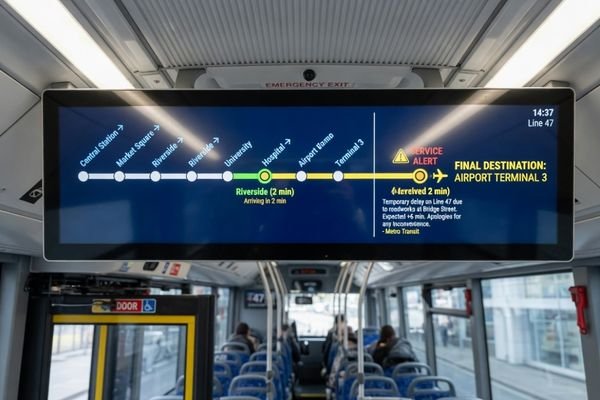
Common use cases include dynamic route maps, next-stop displays, service status messages, door-side indicators, compact ticketing panels, and transportation status strips. In these applications, the display format should be selected together with the content design.
A route display module should not be selected only by diagonal size. Better questions are: how far away will users stand, how much text must be shown, what character height is required, and how much horizontal space is available in the equipment?
Platform, Station, and Vehicle-Mounted Display Scenarios
Ultra-wide LCD modules can be integrated into different transportation environments, but each scenario has different priorities. A station platform module may need stronger brightness and wider viewing angles, while a vehicle-mounted module may need stronger mechanical support and more careful cable routing.
Ultra-wide LCD modules can support platform guidance, station information equipment, vehicle interior displays, door-side indicators, ticketing terminals, and transportation status panels. Each application should be reviewed based on installation space, viewing environment, brightness, mounting method, interface, and reliability requirements.
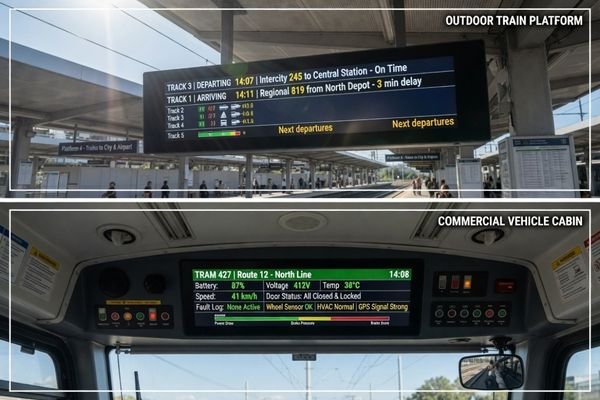
In transportation display reviews, we usually separate the installation scenario before discussing the final module configuration. A platform display, a vehicle interior display, and a door-side indicator may all use ultra-wide LCD modules, but their brightness, viewing angle, vibration, cable routing, and service requirements can be very different.
Station and Platform Applications
Station and platform applications are often viewed by many users from different angles and distances. The module may be installed above a platform, near a gate, inside a ticketing area, or within a wayfinding panel. Engineers should review brightness, viewing angle, cover glass, optical bonding, operating temperature, and long-term display stability.
Outdoor or semi-outdoor platform equipment may require high brightness or sunlight readable LCD module options. However, brightness alone is not enough. Cover glass, surface treatment, installation angle, and reflection control can all affect real readability.
Vehicle-Mounted Applications
Vehicle-mounted LCD modules may be installed inside buses, trains, trams, service vehicles, or transport equipment cabins. These projects usually need stable mounting, vibration consideration, compact cable routing, and reliable connector access.
Because ultra-wide LCD modules are long and narrow, mechanical support along the module length is important. Poor support can create stress, flexing, or vibration-related issues3. FPC direction, connector position, and cable bend radius should be checked early because vehicle interiors usually have limited space behind the display area.
Resolution, Aspect Ratio, and UI Layout Considerations
An ultra-wide LCD module should not be treated as a standard 16:9 screen stretched horizontally. The UI should be designed around the actual aspect ratio, information density, viewing distance, and controller output capability.
The resolution of an ultra-wide LCD module should support the real transportation content: route names, station lists, warnings, icons, and status information. The goal is not the highest pixel count, but a readable layout that matches the screen shape and signal source.
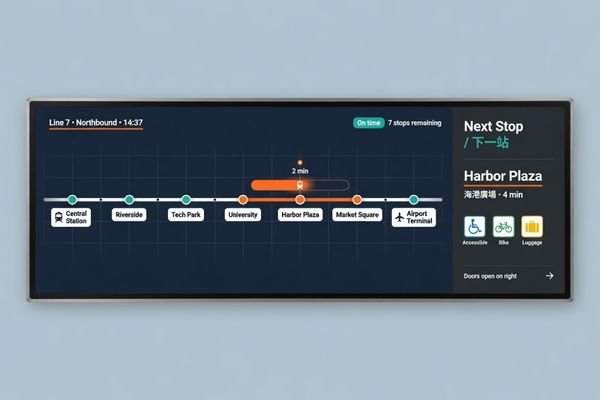
Before confirming the resolution, our engineering team usually asks for sample UI content or a rough layout. Route names, station lists, warning messages, icons, and multi-language content can change the required character height, pixel density, aspect ratio, and controller output. A suitable ultra-wide LCD module should support the real information layout, not force the software team to stretch a standard 16:9 interface.
| Content Type | Resolution Concern | UI Review Point |
|---|---|---|
| Route maps | Enough horizontal pixels for station flow | Avoid crowded labels and unreadable station names |
| Next-stop messages | Clear character height | Match viewing distance and installation height |
| Service alerts | Fast recognition | Keep warning content visible without excessive scrolling |
| Door-side indicators | Compact layout | Balance size, brightness, and viewing angle |
| Multi-language content | More text space may be needed | Check character width and line structure early |
Non-standard aspect ratio LCD modules may also require careful review of timing, signal mapping, and interface compatibility. A higher resolution can improve text clarity4, but it also increases bandwidth requirements for the controller board.
Brightness, Viewing Angle, and Reliability Requirements
Transportation environments vary widely. Some ultra-wide LCD modules are installed inside vehicle cabins with controlled lighting. Others may be installed on bright platforms, outdoor terminals, or sunlight-exposed transportation equipment.
Brightness, viewing angle, and reliability should be selected based on the real installation environment. Indoor vehicle displays, semi-outdoor platforms, and outdoor terminals do not require the same LCD module configuration.
| Requirement | Indoor Vehicle Cabin | Outdoor or Platform Equipment | Key Engineering Consideration |
|---|---|---|---|
| Brightness | Stable indoor brightness may be sufficient | High brightness or sunlight readable performance may be required | Match brightness to peak ambient light and installation angle |
| Viewing Angle | Passengers may read from seats, aisles, or side positions | Users may read from different distances and side angles | Review wide-viewing-angle LCD module options |
| Reliability | Backlight lifetime should match the operating schedule | Temperature, brightness stability, and front-stack protection should be reviewed | Confirm requirements based on the final device environment |
| Dimming | Night operation may require lower brightness | Outdoor use may require adaptive or wide-range dimming | Review PWM control or system brightness adjustment |
| Front Stack | Cover glass may be simple or not required | Cover glass, optical bonding, or surface treatment may be needed | Evaluate reflection, durability, and readability together |
Wide viewing angle is especially important in transportation. Passengers may read the display while standing, sitting, moving, or viewing from the side. If viewing-angle performance is weak, information may look dim or shifted from some positions.
When platform or outdoor equipment needs stronger visibility, you can Explore high brightness display modules to compare available module directions before deciding whether standard brightness, high brightness, optical bonding, or additional front-stack treatment is needed.
Interface, Mechanical, and Custom Integration Factors
Ultra-wide LCD modules used in transportation equipment often require more careful integration review than standard rectangular modules. Their non-standard aspect ratios, long mechanical structure, and special resolutions can affect interface timing, controller compatibility, mounting design, and cable routing.
Before finalizing an ultra-wide LCD module, engineers should review installation space, active area, viewing distance, brightness, interface, FPC direction, connector position, mounting method, cover glass, and lifecycle requirements together.
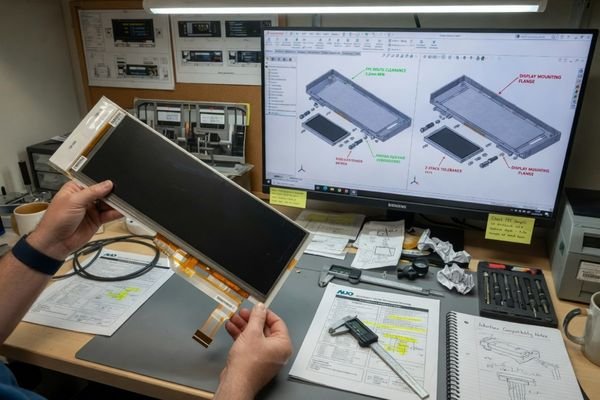
For custom transportation display modules, our engineering review usually checks interface timing, FPC direction, connector position, mounting support, cover glass structure, brightness target, operating temperature, and lifecycle requirement together. These details often decide whether a standard bar type LCD module can be used directly or whether customization is needed.
| Selection Factor | Why It Matters |
|---|---|
| Installation space | Determines module size, outline dimension, and aspect ratio |
| Target display area | Affects active area, viewing area, and UI layout |
| Viewing distance | Determines character height and resolution requirement |
| Interface | Must match controller output, bandwidth, and timing |
| FPC direction | Affects cable routing, assembly, and serviceability |
| Mounting method | Impacts vibration resistance and mechanical stability |
| Cover glass / touch | Changes thickness, readability, and integration structure |
| Lifecycle requirement | Affects long-term supply and replacement planning |
Ultra-wide LCD modules usually use panel-level interfaces such as LVDS, eDP, or MIPI. If the host system outputs HDMI, a matching driver board or signal conversion solution may be required. The correct interface depends on resolution, refresh rate, bandwidth, signal source, controller platform, and final device architecture.
Discuss your custom display project before finalizing the aspect ratio, interface, and mechanical structure. Early review of mechanical drawings, controller specifications, brightness requirements, and production expectations can help reduce integration risk.
Ultra-Wide LCD Module FAQ
What is an ultra-wide LCD module used for in transportation?
Ultra-wide LCD modules are often used for passenger information, route displays, station guidance, vehicle interior displays, door-side indicators, ticketing terminals, and transportation equipment status panels.
Why use a bar type LCD module instead of a standard 16:9 LCD?
A bar type LCD module fits long and narrow spaces better. It is also more suitable for horizontal information such as route names, station lists, alerts, operating status, and guidance content.
What resolution is suitable for transportation route displays?
The resolution should be selected based on display size, viewing distance, character height, UI layout, and controller capability. Ultra-wide LCD modules should not simply stretch standard 16:9 content.
Do transportation LCD modules need high brightness?
It depends on the installation environment. Indoor vehicle displays may only need stable standard brightness, while outdoor platforms, kiosks, or sunlight-exposed terminals may require high brightness or sunlight readable LCD modules.
Which interface is suitable for ultra-wide LCD modules?
LVDS, eDP, MIPI, or a driver board solution may be used depending on resolution, bandwidth, controller output, and project requirements. Interface timing should be confirmed before prototype development.
Can ultra-wide LCD modules be customized for fixed equipment space?
Yes, depending on project requirements. Customization may involve brightness, cover glass, touch integration, interface adaptation, FPC direction, cable design, mounting review, or mechanical structure evaluation.
Conclusion
Ultra-wide LCD modules are useful in transportation equipment because they fit narrow spaces and display route, station, status, warning, and guidance information efficiently. They are suitable for passenger information panels, route display modules, station guidance equipment, vehicle-mounted LCD modules, door-side indicators, and transportation service terminals.
Successful integration is not only about selecting a long display format. Engineers should review aspect ratio, resolution, brightness, viewing angle, interface, mechanical space, FPC direction, mounting method, cover glass, reliability, and long-term supply before finalizing the LCD module.
Not sure which ultra-wide LCD module fits your transportation equipment project? Start by preparing the installation space, target display area, resolution, interface, brightness requirement, viewing distance, mounting method, FPC direction, cover glass requirement, and expected production plan.
→ Start your ultra-wide LCD module project
✉️ info@lcdmodulepro.com
🌐 https://lcdmodulepro.com/
-
ScienceDirect. “User Experience with Ultrawide Curved Displays.” ↩
-
Wikipedia. “16:9 Aspect Ratio.” ↩
-
Focus LCDs. “Vibration-Induced LCD Failures: A Mechanical Perspective.” ↩
-
The Hardware Hub. “How Does Screen Resolution Affect Text Clarity?.” ↩