Custom LCD module development usually fails for practical reasons, not because one single specification is wrong. A sample may light up on a lab bench, but that does not prove the module will fit the enclosure, match the controller board, stay readable in the real environment, or move smoothly into repeatable production.
The most common risks in custom LCD module development include unclear requirements, mechanical fit problems, interface compatibility issues, optical stack mistakes, power and thermal limits, production inconsistency, and long-term supply risk. Most of these risks can be reduced through early LCD module integration review before the design is finalized.
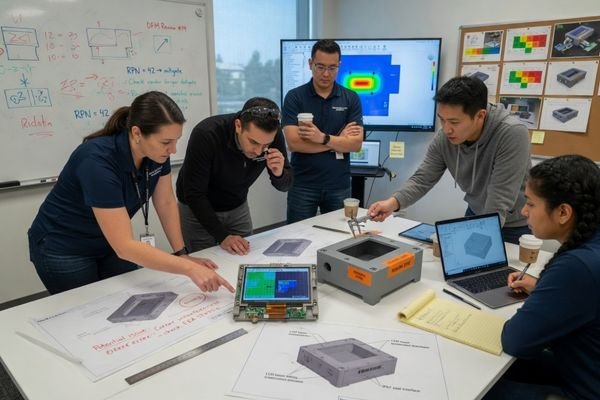
In successful custom LCD projects, project information is usually shared early: application environment, mechanical drawings, controller board interface, brightness target, touch requirements, cover glass structure, expected quantity, and production schedule. These details help identify risks before they turn into redesign, sampling delays, or production problems1.
This article maps common LCD module development risks to practical prevention actions. The goal is not only to make the first sample work, but to confirm that the LCD module can be integrated, validated, assembled, sourced, and supported through the expected product lifecycle.
Custom LCD Development Risks Usually Start Before Prototyping
Many custom LCD development risks are already present before the first prototype is built. They often come from incomplete requirements, separated engineering reviews, or decisions made before the full device context is clear.
Most custom LCD development risks are not caused by one missing specification. They usually come from reviewing the LCD module separately from the customer device, controller board, enclosure, optical stack, power design, and production plan.
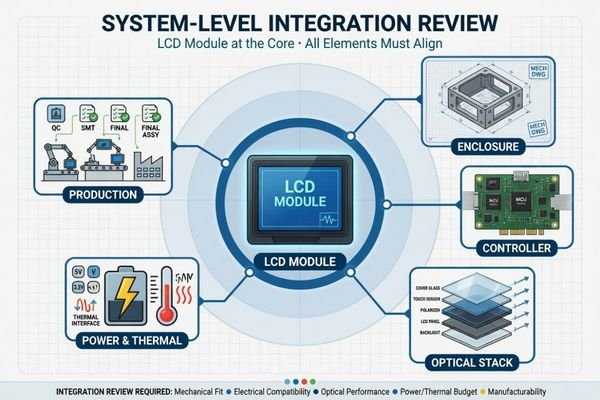
In early custom LCD module reviews, our engineering team usually starts by checking the application environment, mechanical drawing, interface output, brightness target, touch structure, expected quantity, and lifecycle requirement before recommending a module direction. These details help identify whether the main risk is mechanical fit, signal compatibility, optical performance, power design, or production feasibility.
For applications such as transportation systems, industrial control equipment, smart terminals, outdoor kiosks, and measuring devices, these risks can vary significantly. A module that works in one device may fail in another if the enclosure, controller board, installation angle, or operating environment changes.
For projects that require deeper evaluation before sampling, custom LCD module engineering can help align requirements, feasibility, sample validation, and production planning before the module direction is locked.
The Illusion of a “Simple” Specification
Many projects begin with a short request: size, resolution, and brightness. That is understandable, but it is not enough for custom LCD module development. Without application context, mechanical drawings, interface details, and lifecycle expectations, the selected module may look suitable on paper but fail during integration.
Common hidden issues include an FPC that exits in the wrong direction, a viewing area that does not match the front opening, timing that does not match the controller board, or a brightness target that ignores cover glass and outdoor reflection.
The Value of Early Engineering Review
Early engineering review does not remove every risk, but it makes the project path more predictable2. The first prototype should not only prove that the LCD module can light up. It should also confirm that the module direction is suitable for device integration and production planning.
| Risk Area | Common Failure | Prevention Action |
|---|---|---|
| Requirements | Key conditions are missing | Prepare application, drawings, interface, quantity, and lifecycle plan |
| Mechanical Fit | Module cannot be assembled correctly | Check outline, active area, viewing area, FPC direction, and connector clearance |
| Interface | Display fails or behaves unstably | Confirm timing, pinout, voltage, lane count, and driver board needs |
| Optical Stack | Screen looks unreadable in real use | Review brightness, cover glass, touch, bonding, and reflection control |
| Power / Thermal | Brightness or reliability drops over time | Check backlight power, dimming, heat path, and operating temperature |
| Production | Sample works but batch supply fails | Review BOM stability, EOL risk, inspection method, and alternatives |
Risk 1: Unclear Requirements and Incomplete Project Information
One common risk is starting the project with incomplete information. Size, resolution, and brightness are useful, but they do not define the full engineering requirement.
A custom LCD module cannot be reviewed properly without application context, interface information, mechanical constraints, optical requirements, production quantity, and lifecycle expectations. Missing inputs often lead to recommendations based on assumptions rather than real project conditions.
Useful project inputs include the application environment, interface type, mechanical drawing, viewing distance, touch requirement, cover glass design, operating temperature, expected quantity, production schedule, and lifecycle expectation.
| Required Information | Why It Matters |
|---|---|
| Application environment3 | Defines brightness, temperature, vibration, and reliability needs |
| Mechanical drawing | Confirms fit, active area, viewing area, and mounting method |
| Interface type | Reduces timing, signal, and driver board compatibility risk |
| Touch / cover glass | Affects optical stack, thickness, and front-panel design |
| Operating temperature | Helps review backlight, thermal behavior, and reliability needs |
| Estimated quantity | Helps evaluate customization feasibility and production planning |
| Production schedule | Supports lifecycle, lead time, and supply continuity planning |
For example, an LCD module may have the correct size and resolution. But if the device is used outdoors, the project may also need high brightness, optical bonding, anti-reflective cover glass, and thermal review. If the enclosure is already fixed, the module outline, active area, connector position, and FPC direction become just as important as the display size.
Risk 2: Mechanical Fit Problems After Module Selection
Mechanical problems often appear when the LCD module is selected before the enclosure, front opening, active area, viewing area, connector clearance, FPC direction, stack-up thickness, and mounting method are reviewed together.
A module with the right diagonal size can still fail mechanically. The real question is whether the full LCD module, cable route, connector area, touch layer, cover glass, gasket, and mounting structure can fit and assemble reliably inside the device.
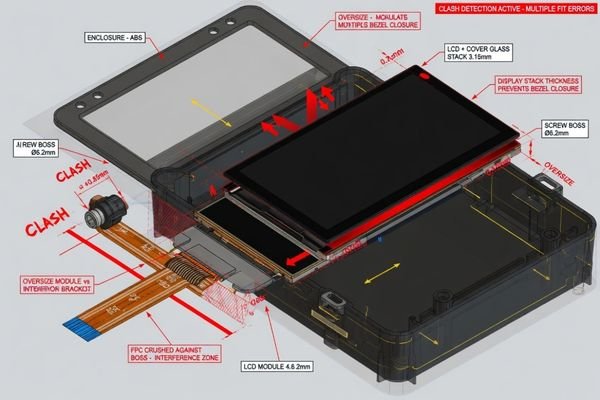
During mechanical review, we usually compare the module outline, active area, viewing area, enclosure opening, connector position, FPC direction, cable route, and stack-up thickness before the LCD module direction is frozen. This helps prevent a module from looking correct in a datasheet but failing during real assembly4.
| Mechanical Risk | What Can Go Wrong | How to Avoid It |
|---|---|---|
| Active area mismatch | Useful pixels are covered by the front panel | Check active area, viewing area, and enclosure opening together |
| Viewing area misalignment | UI appears off-center after assembly | Confirm UI safe area and front-window alignment |
| Module outline conflict | Module hits brackets, screw bosses, or PCBs | Review 2D drawings and 3D layout early |
| FPC direction conflict | Cable bends sharply or hits internal parts | Check FPC exit direction with the enclosure layout |
| Connector clearance | Assembly or service becomes difficult | Confirm connector access and locking space |
| Stack-up thickness | LCD + touch + glass exceeds available depth | Review full Z-height before design freeze |
| Tolerance stack-up | Prototype fits but batch assembly shifts | Include adhesive, gasket, and housing tolerances |
Mechanical risk is reduced by exchanging 2D drawings, 3D models, and cable layout information early. The goal is to confirm that the LCD module can be mounted, aligned, connected, inspected, and serviced before the module direction is finalized.
Risk 3: Interface, Timing, and Signal Compatibility Issues
Interface compatibility is one of the highest-risk areas in custom LCD module development. LCD modules usually use panel-level interfaces such as LVDS, eDP, MIPI, or RGB. They should not be treated like standard HDMI monitors.
Interface compatibility is not only about matching names such as LVDS, eDP, MIPI, or RGB. It depends on signal timing, pin definition, voltage level, lane count, data mapping, connector type, cable length, and driver board or adapter board requirements.
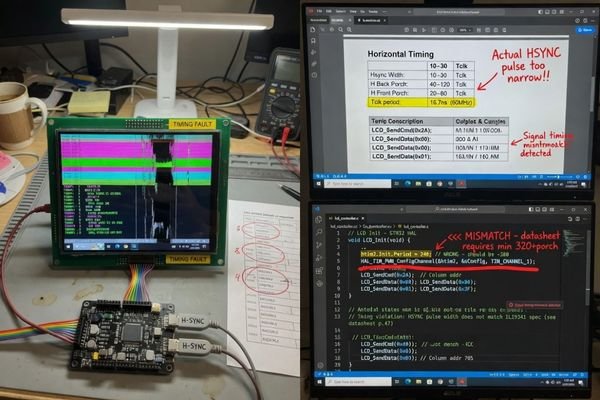
For interface review, we usually compare the host controller output with the LCD panel timing, pin definition, voltage level, lane count, connector type, cable length, and driver board requirement before sample production. A matched interface name does not always mean the signal path is ready for stable operation.
Most LCD modules do not accept HDMI directly. If the host system outputs HDMI, a driver board or signal conversion solution may be required to match the LCD panel timing and interface requirements. Even when the interface name appears correct, the module may not work unless the controller board output and panel input are properly matched.
| Interface Item | What to Check | Risk if Missed |
|---|---|---|
| Timing | Pixel clock, sync format, refresh rate | Flicker, unstable image, or no display |
| Pinout | Connector definition and signal mapping | Wrong image, abnormal color, or no output |
| Voltage | Logic voltage and backlight power | Electrical failure or unstable operation |
| Lane count | LVDS/eDP/MIPI channel configuration | Bandwidth mismatch |
| Cable length | Signal integrity and routing | Dropout or intermittent display |
| Driver board | Need for HDMI/LVDS/eDP conversion | Extra cost, space, and validation work |
The risk is higher for ultra-wide bar type displays, square LCD modules, round LCD modules, or high-resolution formats. These modules may require special timing, multi-channel LVDS, 4-lane eDP, MIPI configuration, or a dedicated driver board.
Discuss your custom display project before the LCD module, controller board, and cable design are fixed.
Risk 4: Brightness, Touch, and Optical Stack Problems
Brightness and readability problems often happen when the LCD module is evaluated only by its nit rating. A high brightness LCD module may still be difficult to read if cover glass reflection, PCAP touch loss, air gaps, poor contrast, or outdoor glare are not reviewed.
Brightness, touch technology, cover glass, bonding method, and surface treatment are connected parts of the LCD module optical stack. Every layer added in front of the LCD can reduce transmission, add reflection, or change perceived contrast.
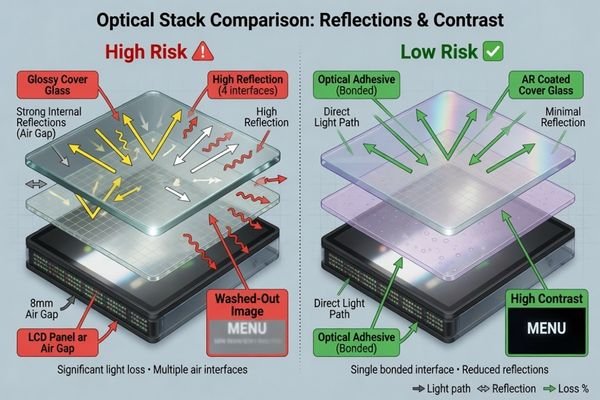
For outdoor or high-ambient-light projects, sunlight readability depends on more than backlight power. Optical bonding, anti-glare treatment, anti-reflective coating, suitable cover glass, and reflection control may be required. These choices should be reviewed before the LCD module structure is finalized because they affect thickness, cost, thermal behavior, front-panel design, and production process.
Explore high brightness display modules when your project requires sunlight readability, outdoor visibility, or stronger performance under high ambient light. For sunlight-readable projects, the LCD module should be reviewed together with cover glass, touch structure, optical bonding, reflection control, and thermal design.
The key point is simple: optical and touch decisions should not be treated as accessories added after LCD selection. They are part of the custom LCD module design.
Risk 5: Power, Thermal, and Reliability Risks
Power and thermal risks are often underestimated. LCD logic power and backlight power may use different power domains, and high brightness backlights can increase current, heat, and driver design requirements.
High brightness is not an isolated display parameter. It is connected to power budget, backlight driving, thermal path, operating temperature, duty cycle, brightness stability, and expected lifetime.
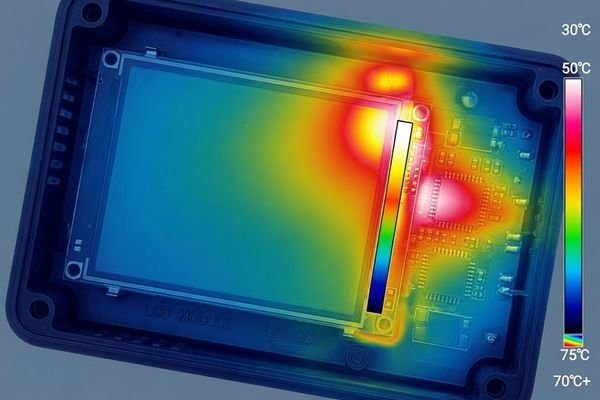
| Risk Area | Key Considerations | Engineering Review Action |
|---|---|---|
| Power Design | Logic power, backlight power, driver, PWM dimming | Confirm power requirements and driver strategy early |
| Thermal Behavior | Backlight heat, sealed enclosure, high ambient temperature | Review thermal path and brightness stability |
| Backlight Reliability | Continuous operation, dimming method, thermal stress | Match brightness target with duty cycle |
| Environmental Exposure | Temperature, humidity, vibration, shock, ESD | Review based on real application conditions |
| Cable and Layout | Backlight cable, power routing, connector load | Check cable path and connector position before design freeze |
For high brightness LCD modules, thermal review is especially important. A backlight may perform well during a short test, but heat buildup during long operation can reduce stability. The issue becomes more serious in sealed outdoor devices, vehicle-mounted equipment, and compact industrial terminals where heat cannot escape easily.
LCD modules are components, and final device reliability depends on the complete device design. The engineering goal is to review LCD module integration risks early so that power, thermal, and reliability limits are not discovered too late.
Risk 6: Prototype Success but Production Failure
A custom LCD module project should not be considered complete just because the first sample lights up. Prototype success does not always prove production readiness.
Prototype success does not prove production readiness. A custom LCD module should be validated for repeatable assembly, cable routing, optical stack consistency, BOM stability, inspection criteria, approved alternatives, and lifecycle support before volume production begins.
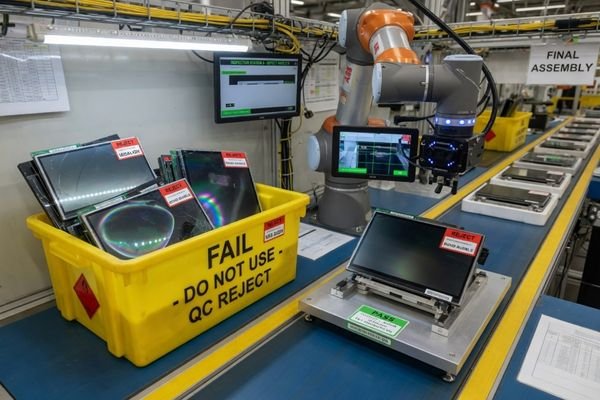
Before moving toward production, our engineering review usually checks BOM stability, assembly tolerance, inspection criteria, approved alternatives, packaging, and lifecycle risk so that a working sample can become a repeatable production item. A sample that lights up is only one checkpoint; it is not the same as production readiness.
| Production Risk | What Can Happen | Prevention Action |
|---|---|---|
| BOM instability | Key parts become unavailable | Review lifecycle and approved alternatives |
| Assembly variation | Batch units do not align consistently | Define tolerance and inspection criteria |
| Cable supply risk | FPC or connector changes delay production | Confirm sources and replacement options early |
| Optical inconsistency | Brightness, bonding, or cover glass quality varies | Define acceptance criteria before production |
| Packaging risk | Module is damaged during handling or shipment | Review packaging and transport protection |
| EOL risk | Panel, IC, connector, or cable becomes unavailable | Check lifecycle status before production |
Hand-built samples can hide assembly tolerance issues, cable stress, connector availability, cover glass alignment, adhesive consistency, bracket stability, or batch-to-batch variation. A module that works in one sample may still create production difficulty if the assembly method is not repeatable.
For production-oriented projects, a PVT-style review5 can help confirm BOM stability, assembly process, inspection methods, and batch consistency. This does not need to become overly heavy for every project, but production readiness should be reviewed before volume production begins.
Custom LCD Development Risk FAQ
What information is needed before starting a custom LCD development project?
Useful information includes the application, target size, resolution, interface type, mechanical drawing, brightness requirement, touch requirement, cover glass design, operating environment, estimated quantity, and production schedule.
Why do custom LCD module projects fail after the sample stage?
Some projects fail after sampling because prototype validation only checks whether the module can light up. Production may reveal mechanical tolerance, cable routing, connector supply, touch alignment, thermal behavior, batch consistency, or lifecycle problems.
How can interface compatibility risks be reduced?
Interface risks can be reduced by confirming the controller board output, LCD panel timing, pin definition, voltage level, lane count, cable length, connector type, and driver board or adapter board requirement before sample production.
When should mechanical integration be reviewed?
Mechanical integration should be reviewed before the LCD module is finalized, especially when the enclosure, front opening, active area, viewing area, cover glass, FPC direction, connector clearance, or mounting method has strict limits.
Why is brightness not enough to ensure outdoor readability?
Brightness is only one factor. Outdoor readability also depends on reflection control, cover glass, touch layers, air gap, optical bonding, installation angle, thermal behavior, and the final LCD module optical stack.
How can production risks in custom LCD modules be reduced?
Production risks can be reduced by validating assembly tolerance, cable routing, connector availability, optical stack consistency, BOM stability, lifecycle risk, inspection standards, packaging, and approved alternatives before volume production.
What is EOL risk in custom LCD module projects?
EOL risk happens when an LCD panel, connector, driver IC, cable, or another key component becomes unavailable during the product lifecycle. It can be reduced by reviewing lifecycle status, approved alternatives, and long-term supply plans before production.
Conclusion
Common risks in custom LCD module development usually appear when requirements, mechanical fit, interface compatibility, optical stack, power design, production validation, and lifecycle planning are reviewed too late. A successful project is not only about making the first sample light up. It is about creating a module integration path that can fit the device, work with the controller board, meet readability requirements, remain stable in real conditions, and move toward repeatable production.
Not sure where the risk is in your custom LCD module project? Start by preparing your application, target size, interface, mechanical drawing, brightness requirement, touch structure, expected quantity, and production schedule. Our engineering team can help review LCD module integration risks before prototype development.
→ Start your custom LCD module project
✉️ info@lcdmodulepro.com
🌐 https://lcdmodulepro.com/
-
Meegle. “Electronics Design Risk Assessment Template.” ↩
-
New Jersey Department of Transportation. “Risk Management in Preliminary Engineering.” ↩
-
Wikipedia. “MIL-STD-810.” ↩
-
Fractory. “Design for Manufacturing and Assembly (DFMA): Principles Explained.” ↩
-
LCD Module Pro. “EVT, DVT, and PVT for Custom LCD Modules.” ↩